
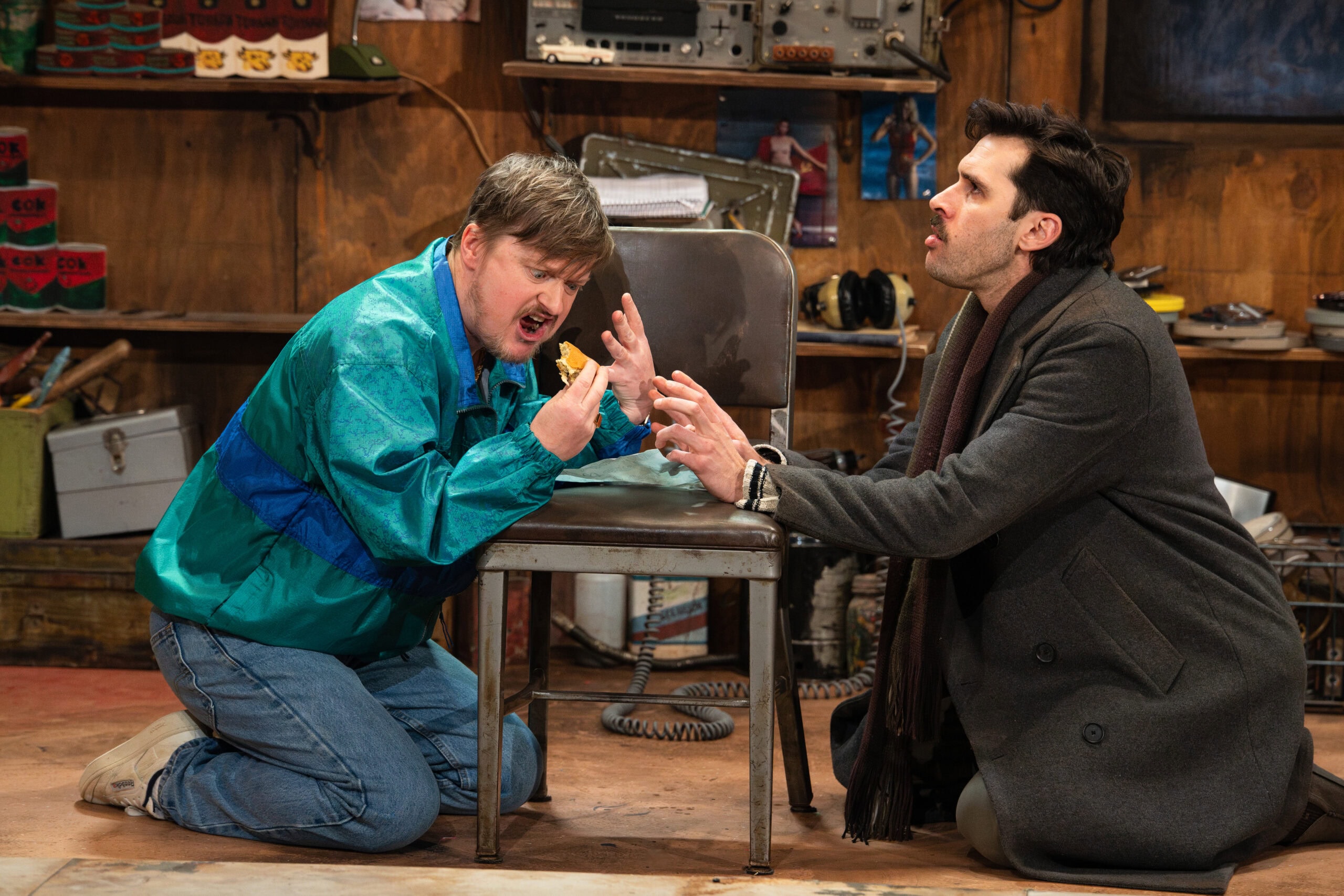
Steven Boyer and Adam Chanler-Berat in Mother Russia. Photo: HanJie Chow
If you’re used to having history served up dry and factual, consider another alternative, now offered at Signature Theatre. Lauren Yee’s Mother Russia, an utterly “bonkers” version of post-Soviet history, is not only the funniest new play in New York this season, but possibly the most insightful political satire in decades.
The year is 1992: Gorbachev is out, Yeltsin is in. The KGB is floundering and the streets of St Petersburg (where the play takes place) are chaotic. Two friends, Dmitri (Steven Boyer) and Evgeny (Adam Chanler-Berat), decide to team up and test out capitalism in this moment of change (Dmitri’s dream has always been to join the KGB and Evgeni wants to prove his worth to his father, a rich Russian mobster). Dmitri has turned his newly open shop (which purports to sell everything from raw chicken to Latvian condoms) into a front for a surveillance enterprise set up with stolen equipment from an abandoned KGB office, and Evgeny convinces his old friend to hire him. Their target: Katya, a famous Russian pop singer (Rebecca Naomi Jones) with whom Evgeny has fallen in love. At the same time, they’re collecting government vouchers with which they hope to invest in the new economy.
Dmitri and Evgeni (reminiscent of SNL’s “wild and crazy guys”) become a two-member gang that can’t shoot straight, as they concoct a scheme to steal a large stash of vouchers from Evgeny’s father. One of my favorite moments occurs when they split a “filet-o-fish” from the newly opened McDonalds, licking their fingers with ecstasy over both the fish and the newly arrived emblem of capitalism. Eventually Katya joins them as the scheme crescendos to a violent shoot-out (no spoilers . . . but then again nothing could spoil the fun of this outrageous plot).
The narrator of this absurdist caper is a fourth character named Mother Russia (played with relish by David Turner). She appears in a violent red costume (designed by Sophia Choi) at the top of the play and between each scene, as the action segues back and forth from Dmitri’s trashy shop to the bus where Evgeni meets Katya to of Evgeni’s father’s mansion (the set, designed by dots, nests most of the locations inside the shell of Dmitri’s shop with a clever use of painted backdrops). At first, she offers random (outrageous) comments (in a heavy Russian accent laced with American slang) on everything from buying furniture in 1992 to the Moscow Art Theatre’s leading lady Olga Knipper, Anton Chekhov’s wife. “There is not enough of me in this play,” she complains at one point. “Have you noticed this? Right?”
About halfway through this ninety-minute romp, Mother Russia delivers one of the most memorable monologues I’ve heard on any stage this year—hilarious and insightful—offering the history of Russia “beginning with the year 7. First there was a war. And then another war. And then a king. And then a tsar. Ivan the Terrible —he was not so bad—then there was Dmitri. Boris. Feodor. False Dmitri. False Dmitri 2.” On and on she goes through two thousand years of Russian history in five minutes, as her speech grows increasingly outrageous, including references to the Beatles, The Godfather characters (specifically Luca Brasi and Moe Green), and ending with Alexi Navalny.
Director Teddy Bergman navigates this caper swiftly and skillfully, intensifying its entertainment value and absurdity, surprising us with each appearance of Mother Russia, who pops up on the roof of the set, in the audience, etc. Other treats include music from the great Russian tradition (Swan Lake in particular) and a dance performed by the ensemble. Above it all, on the roof of the shop, there’s a sign saying (in Russian, of course): “The best part of waking up is Folger’s in your cup!”
Amidst all this hilarity, one line, said by Mother Russia at the beginning and echoed at the end, summarizes the searing, serious historical insight offered by Yee, a Signature resident playwright who turns out to be one of the sharpest minds of her generation. “I have been let down by so many shitty men,” says Mother Russia at the play’s introduction, referring to Russia’s entire history, which she will summarize later in the play. She repeats that sentiment again in the final scene, when she is approached by Evgeny, another “shitty man” now dressed as a businessman, offering her “Russia, in your name . . . what you’ve always wanted.”
“I’ve heard this song before,” Mother Russia replies, “but on the other hand, good parts are so hard to come by these days.”