
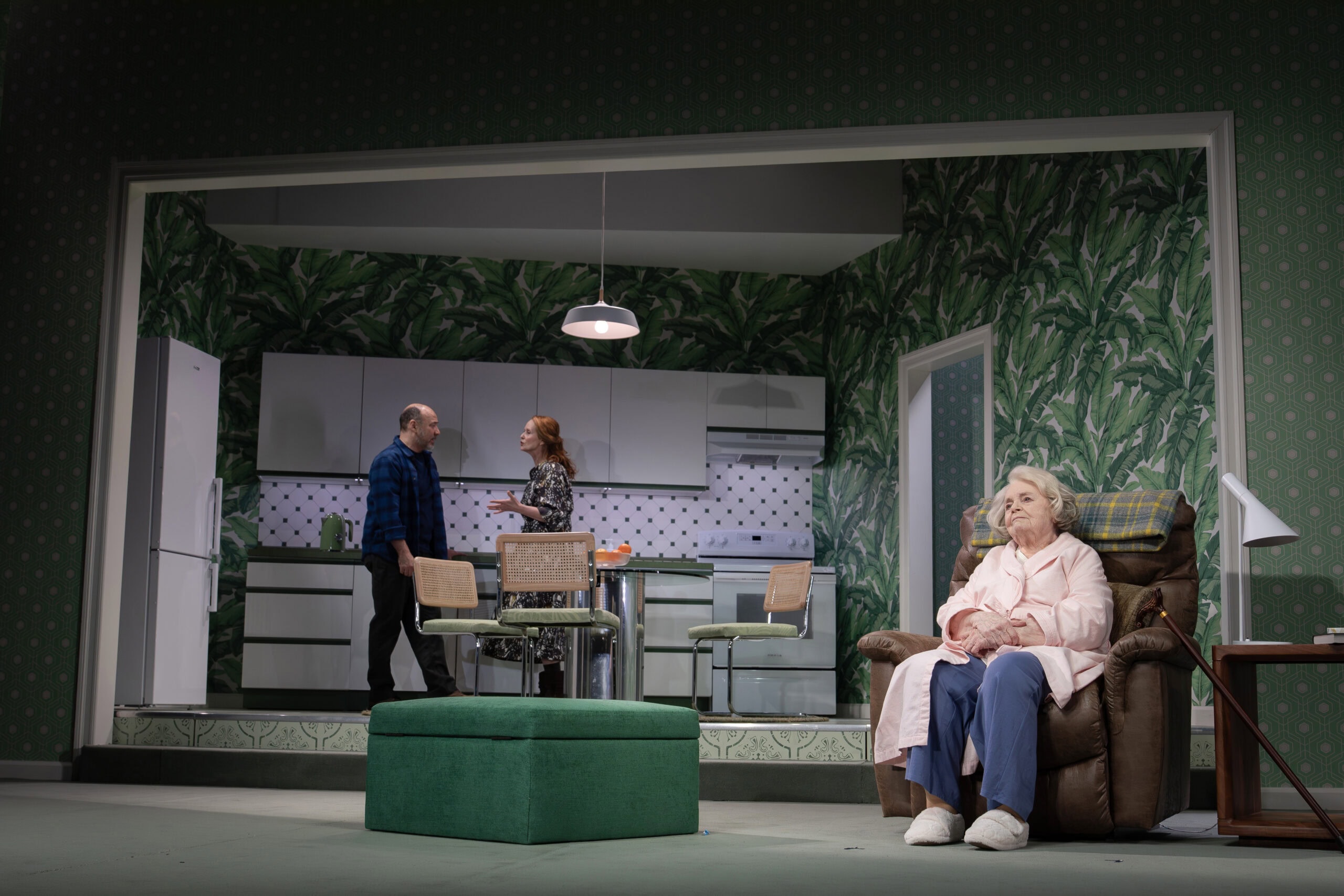
Danny Burstein, Cynthia Nixon, and June Squibb in Marjorie Prime. Photo: Joan Marcus
How often can a playwright be called a clairvoyant?
A case can be made for Jordan Harrison, whose remarkable 2014 play, Marjorie Prime, appears to have predicted the ominous rise of artificial intelligence in our lives today.
This unsettling play, now in performance at the Helen Hayes Theatre on Broadway, features a family who is dealing with aging and loss with the aid of a “prime”—a representation of a deceased person brought to life for the purpose of providing comfort to those who mourn them. An elderly woman named Marjorie (June Squibb) is rapidly losing her memory. Her loving son-in-law, Jon (an affecting Danny Burstein), has requisitioned a “prime” of Marjorie’s deceased husband, Walter (Christopher Lowell), from the Senior Serenity Agency, who offers such services. The purpose: to provide companionship for Marjorie and decelerate her increasing dementia. Walter Prime is in his thirties, an age expressly requested by Jon to align with Marjorie’s early, happy memories. Jon has another motive as well: to improve the contentious relationship between Marjorie and her daughter, his beloved wife, Tess (a conflicted Cynthia Nixon).
The exchanges between the feisty eighty-five-year-old Marjorie and the compassionate thirty-something Walter Prime are tender and touching. Jon has done a thorough job of programming Walter Prime with the highlights of his years with Marjorie. Walter Prime takes pleasure in reminding her of details like their favorite movie (My Best Friend’s Wedding) and the story of how they acquired their dog Toni. Occasionally, when she questions him, Walter Prime will answer: “I’m afraid I don’t have that information…” (meaning that Jon hasn’t programmed him on that topic yet). To that response, Marjorie (who is intermittently aware that Walter Prime is not real) replies: “You’re a good Walter, either way.” On another occasion, when Marjorie apologizes to Walter Prime for her loss of memory, he replies: “Don’t worry. I have all the time in the world.” Yes, that moment is amusing, but also very unsettling.
Jon’s love for his wife is in further evidence in part two, a year later, when Marjorie has died. Jon requisitions a Marjorie Prime for the sake of his grieving wife, who is now suffering a deep depression. This time, Tess is the one who “programs” Marjorie Prime about their life together. As a result, they communicate more deeply and meaningfully than when her mother was alive. “Why is this the way I want to remember her?” Tess exclaims. Her mother replies: “Maybe I’m the Marjorie you still have things to say to.”
In a later scene, there is another loss, and the appearance of yet another prime—but I won’t deprive you of discovering it for yourself. Nor will I spoil the surprise in the play’s final, overwhelming part three. My only hint—there are no living humans present. Is the playwright suggesting that artificial intelligence is immortal, while we human beings are not? Suffice it to say, the power of this scene is enhanced by Anne Kauffman’s deft, understated direction, and the deep, heartfelt performances of this superb cast (Danny Burstein’s momentary breakdown in part two is unforgettable). The interior of Jon and Tess’s home, simply designed by Lee Jellinek and superbly lit by Ben Stanton, features a striking contrast of a plainly patterned green wallpaper downstage and a wildly tropical one upstage, as if to suggest two realities at work simultaneously.
In retrospect, technology is not the main issue that concerns playwright Harrison. “The less the audience is put in mind of how the technology works, the better,” Harrison writes in a script note. In this thought-provoking, insightful play, Harrison appears to be using technology as a vehicle to explore profound, life-defining themes of marriage and family, aging and loss. It’s also interesting to note that this is the third play this season that focuses on a daughter’s quest to know her mother, whether still living or deceased (following Liberation on Broadway and Caroline at MCC Theater).
Ultimately, Harrison reveals his play’s essential message. “How nice that we could love somebody,” says one character at the end. Whether that line is uttered by a living being or a prime doesn’t seem to matter.