
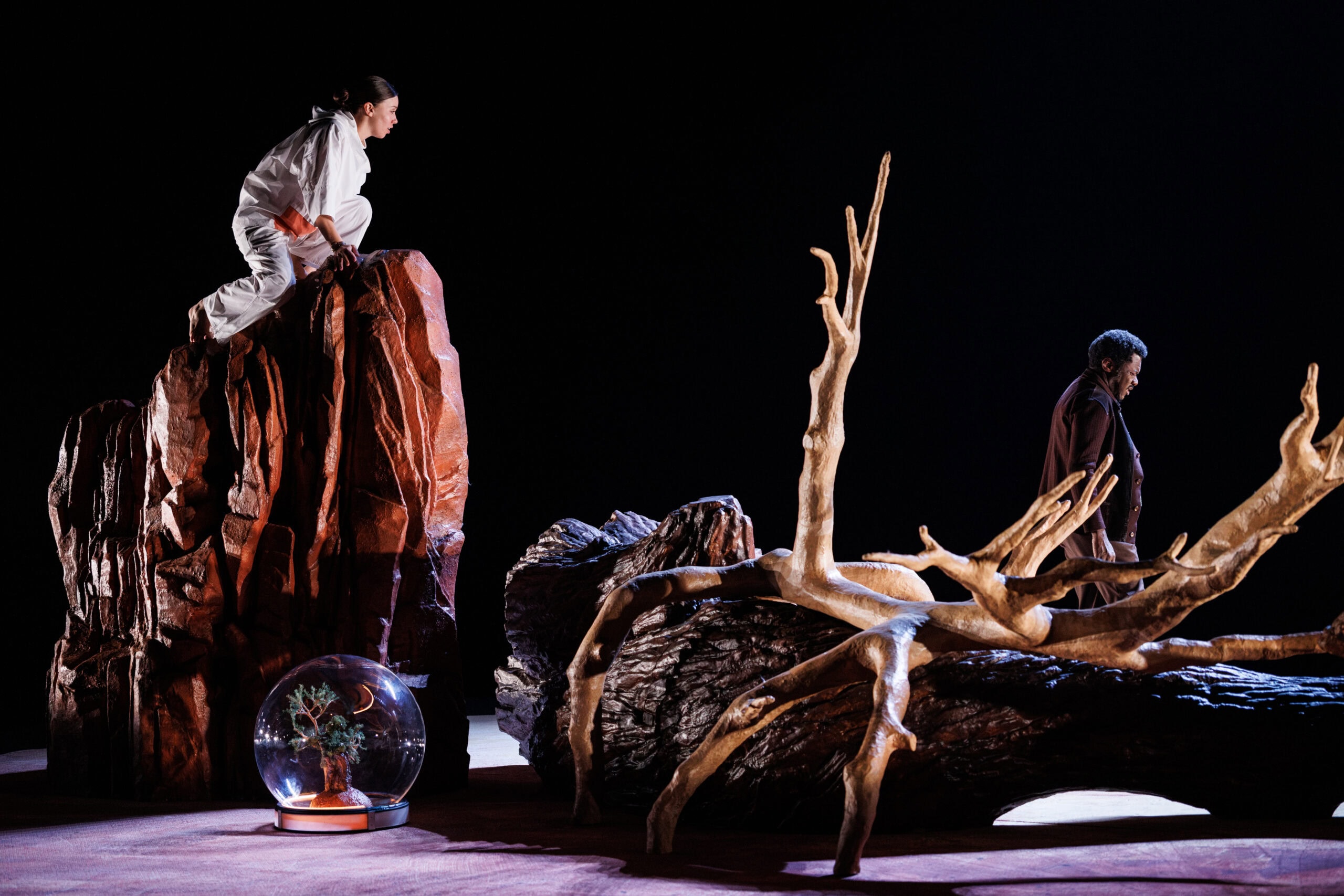
Alison Dechamps and Adama Diop in La Distance. Photo: Maria Baranova
“We are separated by forgetting, which is the greatest distance of all.”
The father and daughter in La Distance, the new piece by Tiago Rodrigues presented as part of BAM’s Next Wave season in conjunction with L’Alliance Francaise, are separated by every possible sense of distance. There’s the almost inconceivable physical distance: Amina (Alison Dechamps) is moving to Mars–140 million miles from Earth. There’s the emotional distance: She doesn’t tell her father, Ali (Adama Diop), that she’s going. There’s the gap between her old life and the new one she is choosing to build on another planet; the grandchildren her father will never meet and the future descendants that will, if they survive, live out their lives completely divorced from what came before. But immigrants have faced such challenges before; what makes La Distance so devastating is that it takes place against the backdrop of a dying planet, and in the shadow of Amina’s conscious decision to slowly forget not just her own past but the whole of human history. For her, it’s an act of survival–turning to face a possible, hopeful future rather than dwell in the wreckage of the recent human past. “We no longer believe it’s possible to change the world. We believe that we need to change worlds,” she says. For her father, it’s a betrayal, not just of their relationship, but of everything he believes–and ultimately a loss he can do nothing but grieve, alone.
When Ali is first asked to record a message for Amina to receive at the end of her monthslong interplanetary journey, he refuses to believe he’s not being scammed. And once he is convinced that Amina really is on her way to Mars, his first message consists mostly of the word “Why?” (“Pourquoi,” to be precise; the performance is in French with English supertitles.) At first he is baffled and bemused, but not terrified–she’s a headstrong child making a dramatic gesture to slip the bonds of an overbearing father, her youthful rebellion scrawled across the galaxy. Like Ali, we are slow to realize the import, and the permanence, of the choice Amina has made; Rodrigues’s worldbuilding, like all good science fiction, reveals its contours gradually.
It’s 2077, and the Earth that Amina is leaving is a planet ravaged by a series of climate and political collapses. Her father can remember a time when it was still safe to go to the beach and swim in the ocean, and a time when it was presumed that each generation would live a life better than that of their parents. But over the course of Ali’s life, human existence has instead become ever more precarious, with accelerating climate change, shortages of basic goods, and nation-state political systems starting to give way to “CorpoNations.” Amina has known nothing but catastrophe after catastrophe, one of which took the life of her mother when she was but a toddler.
Now, she’s turning her back on Earth entirely. She’s put her fate in the hands of the CorpoNation Novus, and become a Forgetter. This means that she’s signing on to the “Protocol,” a treatment that will eventually erase her episodic memory and her memory of Earth’s history. She will retain only the skills and semantic memories necessary to build a new world; only in erasing her consciousness of human history can she retain the possibility of hope for humanity’s future. In the transitional phase, though, before the Protocol fully kicks in, she is expected to communicate with one person on Earth, through recorded voice messages.
La Distance consists of these Mars-to-Earth communiques between father and daughter, each occupying half of a circular turntable with a landscape of dead trees and red rocks. In Fernando Ribeiro’s set, the dying Earth doesn’t look so different from a Mars where people live mostly underground, except that Ali’s side contains objects that speak of human habits and creativity–but in ways that are retro even in 2026: a stack of books, a record player, a mug of tea or coffee, and a handful of printed photographs.(José António Tenente’s costume for Ali is neutral male professional wear that would seem reasonable for most of the past century so that could very well remain true 50 years from now. Amina’s outfit is studiedly neutral, almost like a martial-arts uniform.) Amina’s side of the set has only a glass globe: a tiny terrarium that also evokes a space helmet.
They can’t see each other, can’t speak directly to each other, and as the turntable rotates, according to Rodrigues’s program note, each actor can only speak when they are visible to the audience. (The spinning, at its fastest, is not for the weak of stomach; it’s dizzying to the audience and you can almost see centrifugal force acting on the actors when they stand at the periphery.) Those planetary orbits also mark the time remaining to them: At the moment of conjunction, when Mars passes behind the sun (from Earth’s perspective) and no communication is possible between the two planets for a period of time, the Protocol will complete, and Amina will have forgotten Ali forever.
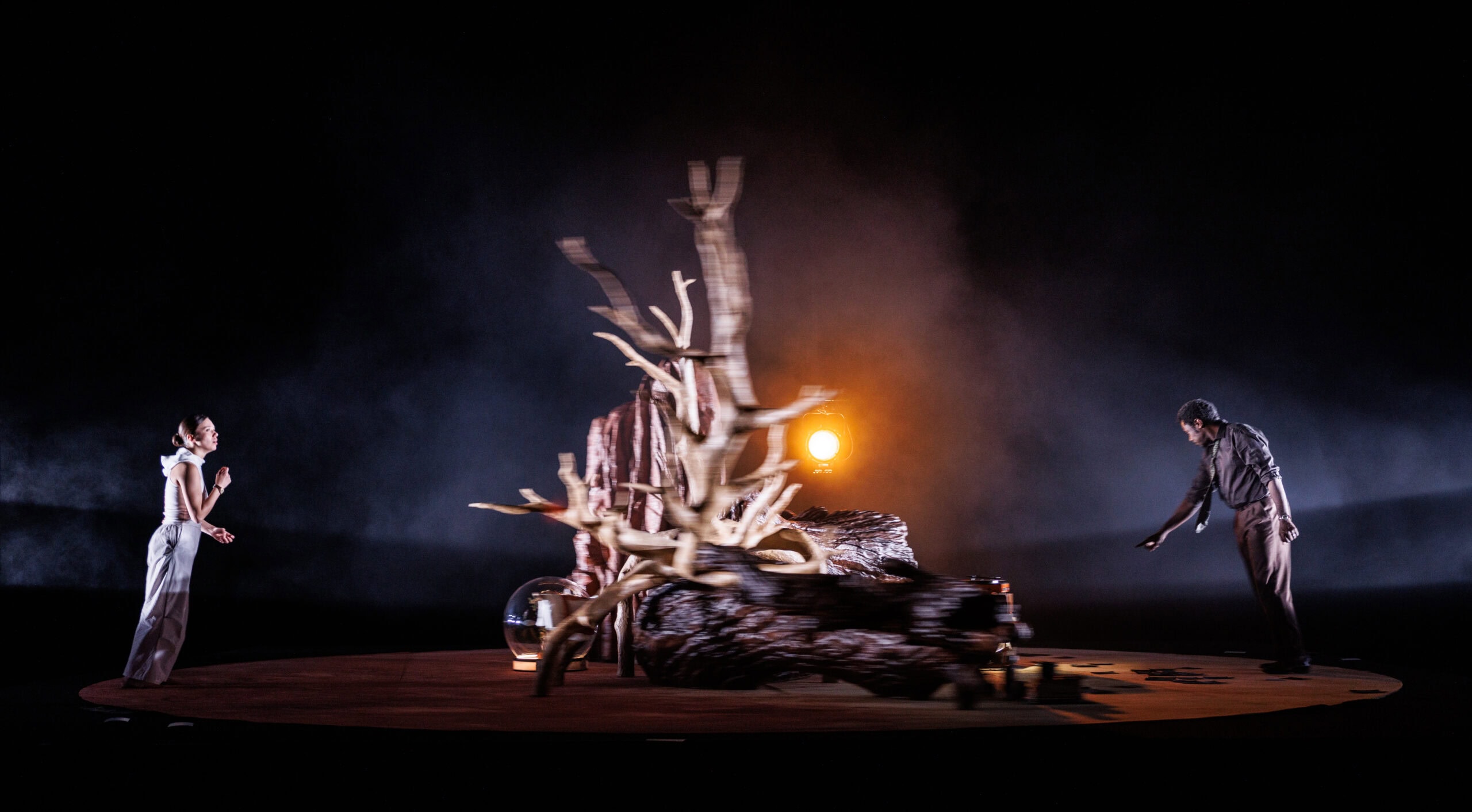
Alison Dechamps and Adama Diop in La Distance. Photo: Maria Baranova.
The “normal” course of memory loss is a parent felled by dementia, a role reversal where the parent slowly dwindles and the child becomes the adult in their dynamic. It’s terrible to live through, but often those with dementia retain their oldest memories, some connection with their past. But seeing the opposite play out proves almost unbearably sad: the young and healthy Amina feeling that only in a complete erasure of all that has come before can she–can humankind–find a sense of hope.
Yet the hope that she feels is utterly at odds with Ali’s understanding of the word: “There are two kinds of hope,” he says. “The hope that I nurture . . . crashes into the imperfection and injustice of the world; but . . . pushes us to do our best with what we have. It’s a hope that suspects it won’t be able to change the world, but keeps on trying. It’s a patient hope, that listens, and that knows that another kind of hope exists. Yes, there is another hope, a cruel one, that demands results and absolute solutions, and that needs to destroy everything to start again from scratch. For centuries, for millennia, that hope has justified horrors.”
But where Ali sees patience and faith, Amina sees a stubborn refusal to recognize that learning from the past will only replicate the past’s mistakes. And her memories soon become painful anchors to a lost world; as Ali flips through photographs trying to resurface stories to tell her, she begins to drift farther away, until finally she snaps at him, “Why do you waste your time telling me about these photographs?…I think your daughter has made a final decision.” Even her own name becomes a data point she is ready to forget.
It’s always difficult to gauge performances in a language you don’t speak, but even in French, you feel the push-pull that must have governed this relationship. Ali, a single father who saved his toddler daughter from Collapse #2, a doctor struggling in a world of crumbling polities and declining resources, finds his daughter’s choice unconscionable, at first, and Diop throws all his paternal authority behind his interrogations. Dechamps’s Amina begins with reserve–she knows she needs to persuade Ali to support her–but over time, you sense that the intimacy of these messages has brought something new into their relationship. When she finally admits her fears and doubts to her father, it feels like a reset of their relationship: but a reset far too close to the end of their relationship. He begins by asking Why—why she’s done such a thing—and she ends by asking Who—who he is to her. “It’s very kind of you to explain the nature of our relationship,” she says, with disinterested mildness.
This inexorable countdown, the spinning circle of time and orbit, the two strong-willed figures proceeding ever farther away from each other–the tension mounts as the days tick down, until, at the end, Ali’s last communication (a handwritten letter, which Amina will never see) slows back down to a simple message of support and hope–hope for himself, perhaps more than for her. But which version of hope? The steadfast belief in incremental change, or the dramatic rupture that could bring transformation–or horror? We don’t know.