
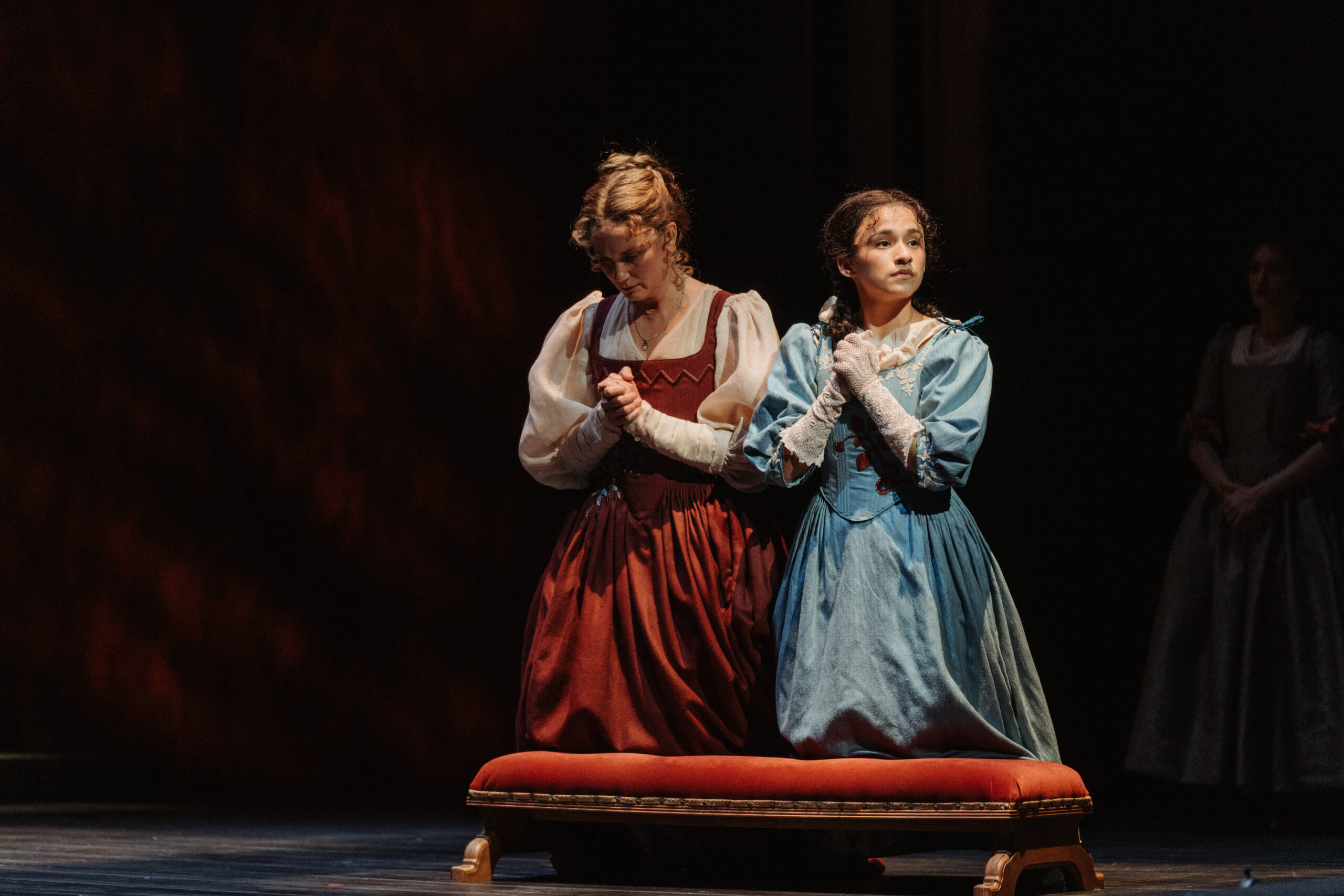
Jennifer Nettles and Naomi Serrano in Giulia: The Poison Queen of Palermo. Photo: Andy Henderson
Giulia: The Poison Queen of Palermo (with book, music, and lyrics by Jennifer Nettles, who also plays the title role) is two-thirds of the way to being a genuinely exciting new musical, starting with (most of) its songs, which draw on a variety of musical styles but still build to a score full of both catchy hooks and recurring motifs. Nettles has identified a compelling heroine with an annoyingly-still-relevant historical story to tell, and she tackles social issues in a way that’s both forthright and sensitive, rather than leaving them buried in the subtext. Mary Zimmerman’s direction is visually fluid; Austin McCormick’s choreography is intelligent and well integrated into the narrative. (One particular movement sequence that’s part dance, part slow-motion fight, dramatizing the way time slows down in a moment of crisis, is particularly striking.) Daniel Ostling’s elegantly spare set turns into a clever box of tricks, as new landscapes and locations are revealed every time its upstage doors are opened.
But that other third feels like a show that’s not yet fully realized. The storytelling and language choices are messy. The leading male characters are cartoonishly villainous, and the plot machinations through which they work together to take down the heroine, Giulia, are barely sketched. Certain themes need to be thought through more rigorously. In short, while Nettles and Zimmerman have done some remarkable groundwork, the piece in its present form could really use another eye: perhaps a book writer and/or dramaturg would get it across the finish line.
It’s Palermo, 1653, as we’re told in the opening number by La Capitana (Bre Jackson), a somewhat opaque figure who’s part narrator, part fortune-teller, part deus ex machina for Giulia. It’s a summer of drought, and Milan and Venice are both suffering from plague. Giulia Tofana (Nettles) was a real person, an apothecary who—if legend is to be believed—formulated a custom poison that killed hundreds of men. Nettles’s approach to the story is to make Giulia not a serial killer but a gifted healer backed into a terrifying corner. She helps women of limited means get pregnant and end unwanted pregnancies they can’t afford to keep, and also treats “the French pox” and the petty ailments of the rich and powerful. But she’s also a woman in an abusive marriage; we see her shrink from confident, successful businesswoman into timid, placating spouse when her husband (Matthew Amira) comes home angry and berates her for not doing his laundry.
Everything changes the first time Giulia’s daughter, Vitoria (Naomi Serrano), tries to intervene between her mother and stepfather. In a moment of panic, Giulia poisons her husband to protect her daughter, and then makes her newfound power into a weapon that does the same for other victims of violence and poverty and despair. Giulia is at its most powerful when it’s grappling with that very serious material, and in general when it’s inside Giulia’s mind. With economical storytelling and movement, we see the whole dangerous dynamic of her marriage to an unemployed hothead, and the frozen, agonizing moment she faces when Carlo turns on her beloved daughter, whom she has done everything to protect. We hear the travails of the other marriages in her circle–especially that of her former employee Renata (Aubrey Matalon), whose fantasies of married life run up against the hard reality of gender-based violence even before her wedding day. And we see–in what’s effectively a depiction of a PTSD flashback, when one of her clients’ enraged husbands comes for her–how that history of trauma continues to plague Giulia. Nettles is a magnetic performer with a wide range of vocal styles at her disposal, and in act 1, we feel her struggling with the moral weight of Giulia’s choices. (Her duet about ethical nuance with Father Paolo [Sam Simahk], the only non-monstrous man in the piece, is a highlight.)
But beyond that core, the loose ends proliferate. Nettles and Zimmerman don’t always have a grip on the tone: The frequent use of modern idiom (and often lazy modern cliche, especially in the lyrics) feels jarring in a piece that otherwise uses historically inflected neutral language, and a few of the songs feel like self-conscious Hamilton knockoffs. One of Giulia’s customers, the Duchessa (Didi Romero, giving an indelible performance), shifts from entertaining comic foil to major antagonist midway through. A few elements of fantasy don’t quite mesh with the whole—a goat-headed demon that hovers around the cardinal; La Capitana. There’s a really interesting resonance between the punishing drought arising under the rule of powerful men, and the women’s resistance figured as water, growing drop by drop into an unstoppable river–but the way that resistance shifts from targeted and specific protection to Giulia’s “feeling vigilante” muddies the metaphor. And the political corruption subplot between the Cardinale (Quentin Earl Darrington) and the newly appointed local Governatore (Christopher M. Ramirez) doesn’t cohere. In one scene, we see what I thought was the Cardinale refusing the Governatore’s plan, but in the next, they’re clearly allies.
Also, the villainy of both men–not to mention the plethora of violent husbands–gets nailed hard. The Cardinale secretly comes to Giulia to be treated for syphilis, and he is literally shadowed by a figure the script calls “the little devil.” The Governatore is a leering caricature of lechery and venality. (It doesn’t help that in both written dialogue and Ramirez’s performance, the Governatore seems to be in a slightly different play.) But there’s room for the same subtlety with which Giulia is treated: The Governatore comes to town to build aqueducts, which Palermo desperately needs to rescue them from the drought. (Yes, it’s true that once this mission is established, it’s referenced only occasionally and as far as we can see, not executed before he moves on. But that could change.) We see the role of the church with Father Paolo, and with Giulia taking Vitoria to the convent for protection. Yes, the violence of the patriarchy and the corruption of power are key themes of Giulia, but the musical would be stronger if more of its characters were given the complexity and the ethical qualms of Giulia herself.
There is much to love, and much to cheer for, in Giulia: The Poison Queen of Palermo, down to its fantastic “encore” song. (I am not normally a fan of the new trend of “post-credits” scenes in plays, but this one does orient the audience to walk out and feel inspired toward collective action–to add their drops of water to that river.) One more polish, and I’d cheer to see it on Broadway.