
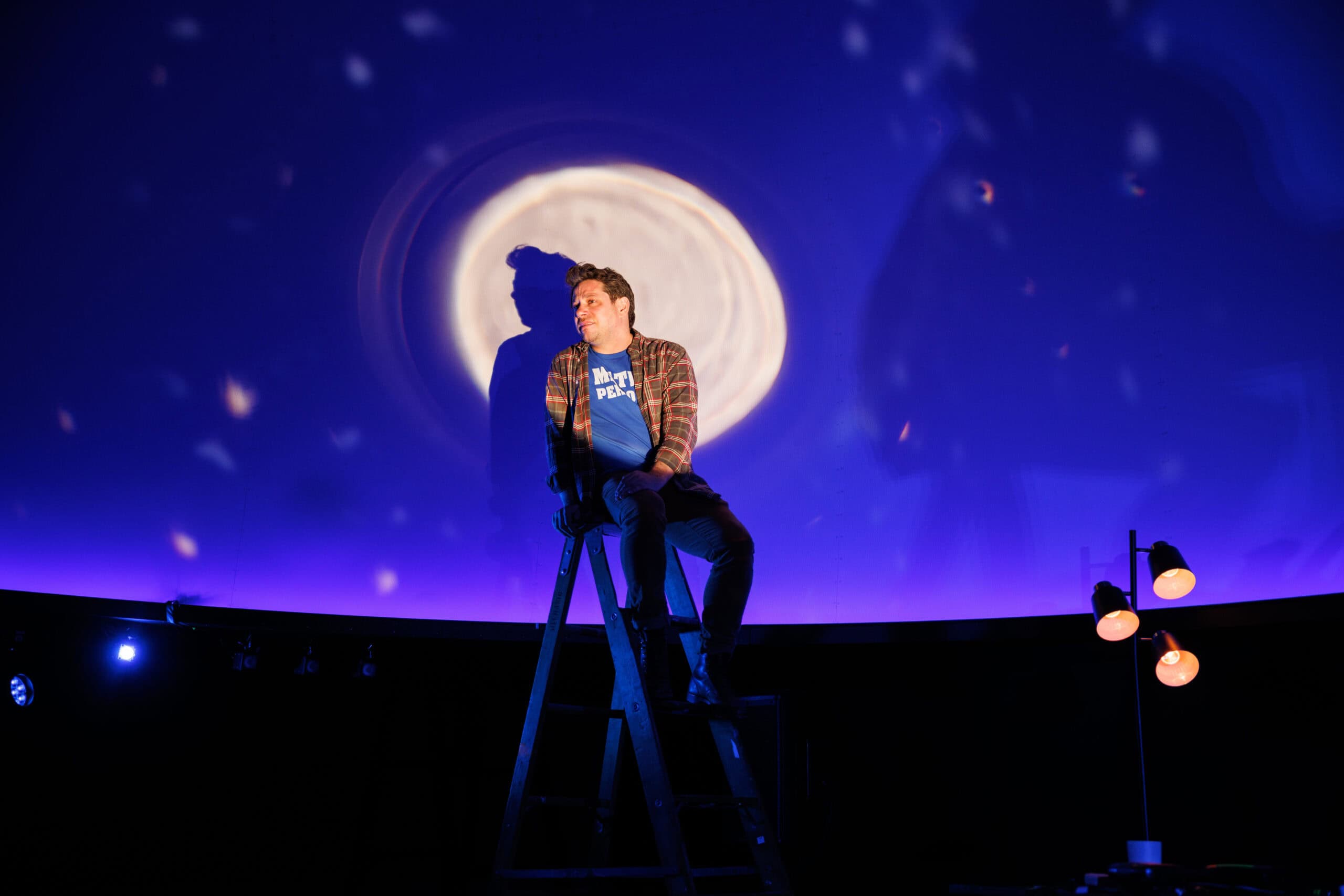
Jared Mezzocchi in 73 Seconds. Photo: Maria Baranova
73 Seconds may take place in a planetarium (and who knew there was a tiny planetarium in the Lower Eastside Girls Club on Avenue D? Sometimes New York can still surprise you), but it looks inward as much as–perhaps more than–out into the depths of space. Creator / writer / performer Jared Mezzocchi and his mother both dreamed of traveling to space, cutting the bonds of gravity–but what Jared learns now is that dementia has led her down a different route toward becoming unmoored from her earthly life. His father has already passed away, so anything lost in his mother’s mind may be hidden from Jared forever–and so he starts, perhaps too late, to dig into the hidden pockets of his own past, trying to put together pieces of the lives his parents lived before him and to remember all the things he chose not to share with them.
As he describes it, he is “memorializing someone who is still alive”: his mother, Rosemary Quinn Mezzocchi, a middle-school math teacher who, in one brief, almost offhand conversation on the night of Jared’s high school graduation, mentions that she worked for NASA as a college intern and then again right after she graduated with her engineering degree. She was later invited to apply to join a space shuttle crew, in the early days of the program when they first started recruiting civilians like teachers. Teachers like Christa McAuliffe, another New Hampshire teacher who became the first teacher in space, and died in the explosion of the Challenger in January 1986. All of this was before Jared was born, and it’s never occurred to him to think of his parents as anything other than how he knows them: public school teachers and administrators in their small New England town.
Rosemary got fairly far into the application process, and then discovered she was pregnant and had to withdraw. No one can say, of course, whether she would have beaten out McAuliffe for that spot. And no one can explain to Jared why, even as she raised a space-obsessed kid who would sneak out of the house to climb up to the roof of their barn to stargaze at the unobstructed New Hampshire sky, she never thought to make her near-miss at heroism–and her near-miss at a tragic death–part of the family lore. But now, when he calls, twenty-plus years after he first heard this story, to ask her to tell him more, her response is “I never worked at NASA.”
As dementia eats away at Rosemary’s memories, her son has to face his own decades of choosing not to know: Not to ask more questions about NASA, or about the experience of watching the Challenger lift off and explode 73 seconds later. Not to ask what she was thinking during his freshman year of college, when she withheld the news of his father’s death from him as he drove 5 hours in a blizzard to get to the hospital where he thought his father’s “condition” was stable. Instead he does what he’s “watched my mom do when she’s holding hard truths. Nothing.”
73 Seconds is his attempt, perhaps too little and perhaps too late, to make something out of that nothing. It’s an apology, an elegy, and an artifact: you can see the consciousness that has gone into crafting this story by which his mother will be remembered. Jared was a child of the nineties and his adulthood has been spent in the age of smartphones and streaming and digital video. His work as an artist generally digs deep into the theatrical possibilities of twenty-first-century technology.
Better known as a director and technologist of multimedia theater than as a writer or a performer, Mezzocchi often builds shows on dizzyingly complex shifts of perspective, intercutting live and recorded video to triangulate multiple approaches to the same story. But here, working with the materials of his own life now trapped in memories only he can access, he’s going analog, revisiting the technology of not just his own early childhood, but his mother’s early adulthood: cassette tapes; the kind of overhead transparency projectors you might remember if you went to high school in the 80s; printed-out family snapshots, color fading so that the 1960s resemble the 1970s resemble the 1980s. (The slight muddying of the period technology also helps to keep a bit of suspense in the Challenger reveal; I did the math before, but not that much before, the narrative gets there–and if I wasn’t old enough to remember watching the liftoff and explosion in the lobby of my high school myself, the suspense might have lasted a tiny bit longer. But those 73 seconds, knowing what’s coming, feel pretty interminable.)
The filmed material here comes in two varieties: archival footage, mostly of the Challenger, with its color palette that looks slightly unnatural from our vantage of HDTV all the time, and live video, taken in the room and projected as Jared manipulates tapes with his hands or creates an illusion of the Milky Way from a projector light in a glass bowl. Ryan Gamblin’s sound design also helps to anchor us in Jared’s childhood: the click of an old-school slide projector, the whirr of rewinding cassette tape.
En Garde Arts, as ever, has made the site-specificity a defining feature of the show–as artistic director Anne Hamburger says, “The space is never just a backdrop, it’s dramaturgy.” The scope of the show is contained in the contrast between the enveloping sweep of the sky in a planetarium dome and the more mundane imagery, the fussy domesticity of the snapshots and of Jared’s hands on the buttons of a cassette recorder. It’s hard to watch something in front of you in a planetarium, a constraint that means director Aya Ogawa and Mezzocchi of necessity have us looking at projections and listening to audio more than looking at Jared.
But the recordings are often more effective than Jared trying to “do” his mother live, which can slide a little too close to affectionate caricature. He’s a storyteller more than an actor, and beyond that, he’s trying to analyze and portray emotions that still make him deeply uncomfortable–a discomfort we can feel when he tries to talk about them.
There’s a Schrodinger’s Cat quality about it all–he, and we, may never be able to open the box and figure out if the cat is alive or dead, if Rosemary nearly went to space or not. He may never even be able to identify the moment when Rosemary passes fully out of his reach. His frustration at missing his moment to find this stuff out comes through–and one of the rawest emotions in the piece is his frustration at the person his mother now is. 73 Seconds often seems to be created and performed for the artist himself as much as for the audience. He asks, “What are secrets if only one of us remembers them?” 73 Seconds, as much as anything else, is making sure we remember those secrets–making sure Jared doesn’t let another chance at memory slip away