
To seal the deal, Cavanaugh must win over the formidable (and, it turns out, foxy) Madame Xi, vice minister of culture. Jennifer Lim, who played the part in Chicago, heads the bilingual cohort of the cast. The American and the Chinese dragon lady are soon discussing a lot more than business and find that even stilted English can be a more effective way of communicating than getting lost in translation. A restaurant scene where Cavanaugh and Xi try to get through to each other in English is Wilmes’s personal favorite. “It’s so much fun,” he said. “We have to communicate and yet we haven’t the words.”
As the U.S. struggles to maintain its economic pre-eminence and China establishes it own form of capitalism, the play is a timely portrayal of a world in flux. “There’s a one-dimensional perception of China in the U.S. as a huge monolith,” Hwang said. “But in reality there’s huge diversity and conflict in terms of the ethnic minorities and the different opinions of where the country should go in the future, I’ve tried to reflect this in the play.”
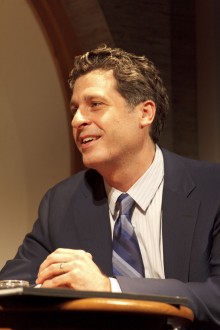
- Gary Wilmes. Photo: Michael McCabe
Madame Xi is determined to embrace the rush to capitalism but her boss Minister Cai, played by Larry Zhang, yearns for the old days. Cavanaugh’s interpreter Peter, played by British actor Stephen Pucci, who has a mastery of Mandarin, loves China’s traditional culture but wants a slice of its lucrative future too.
Some of the few completely serious moments in the play come when Madame Xi delivers two monologues where she reflects on her marriage. Hwang felt it was important to show his Chinese femme fatale’s complexity and point of view. “There’s been a lot said about Western men in Asia, but for a Western audience I thought I needed to make this Asian woman a three-dimensional character and not a stereotype.”
As the cultural and linguistic layers are peeled away on both sides, neither the Chinese nor the Americans gain the advantage. “I have tried to make fun of both sides with an even hand,” said Hwang. “Both Cavanaugh and Xi get something but not everything. It’s realistic.”
The play ends with what appears to be a key piece of advice for foreigners embarking on business in China. “You have to understand your place in their picture,” Cavanaugh says. Hwang acknowledged that was one message of the play. “We’re in transition in the East-West balance of power. Westerners can’t go into China and think they’re at the center of things and the Chinese are historically self-centric as a nation. Westerners are peripheral to that, and it’s wise to recognize that.”
Which begs the question will Hwang take his play to China? He would love to but thinks its subject matter involving a corrupt official and another who commits adultery might be too provocative. “My play M. Butterfly has never been performed in China. It’s seen as too sensitive. So who knows,” he said. Success on Broadway might just help oil the wheels of a future run for Chinglish in the People’s Republic.