
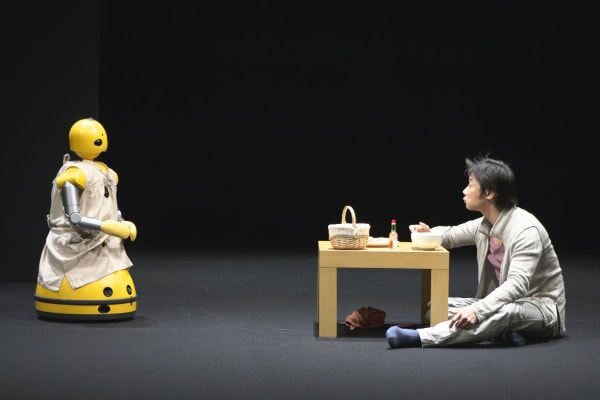
Work experience for robots. Photo: Tatsuo Nambu.
The second play, also by Hirata, features two life-sized robots known as Robovies designed to perform daily activities. Here, they play ‘male’ and ‘female’ domestic helpers to a human couple whose child has recently died. As the robots observe the couple’s grief, they imitate their behaviour. “ Robots learn by memorizing,” says Ishiguro. “They become more human-like by observing humans. But it’s not easy – for example, conversation is hard for robots.”
In the play, the bereaved father (Hiroshi Ota) tries to teach the male Robovie the natural response to his apparently random questions about the planets. He suggests that the robot should ask him, “Why do you ask that?” Later, the two robots discuss what “daijobu” – which roughly translates as “okay” or “all right” – really means. They agree it’s not really in a robot’s vocabulary and that “humans are different.”
Unlike the somewhat spooky Geminoid F, the Robovies, with cute faces that could only have been designed in Japan, are endearing rather than unsettling and, at least at the performance I saw, elicited a lot of laughs. Ota, the actor, says that this can cause problems because the robots can’t react to the audience. “They never forget their lines but we have to accommodate them,” he said. “We have to move round them, and time our lines to theirs.”
As far as Ishiguro is concerned, the activities depicted in these plays may soon be commonplace in our own homes, as robots increasingly perform roles that we no longer want to do. He thinks robots and androids could be very useful in looking after the elderly, especially those with senile dementia. “The elderly like these androids and robots because they can talk to them,” he says.
Ishiguro already puts an android of himself to work by sending his likeness to conferences instead of going himself, operating it via the internet. “Whenever I ask the conference organizer if they would prefer the real me or my android they always pick the android. I get a bit jealous,” he jokes. He also confesses to consulting a cosmetic surgeon about ways to stay looking as young as his android alter ego. I immediately imagine an updated version of The Picture of Dorian Grey.
And as for those other halves, Dr Ishiguro is adamant that we will have robot relationships soon. “I have no doubt we will have robot partners in the very near future,” he says. I sense the premise for another play.
The Robot Theater Project is directed by Oriza Hirata, with robots and androids developed by Hiroshi Ishiguro. It will tour various locations, including Philadelphia Live Arts (15th – 16th February); Flynn Center for the Performing Arts in Burlington, Vermont (21st – 22nd February); Canadian Stage, Toronto, Canada (26th February – 2nd March); and Andy Warhol Museum, Pittsburgh, Pennsylvania (8th – 9th March).