
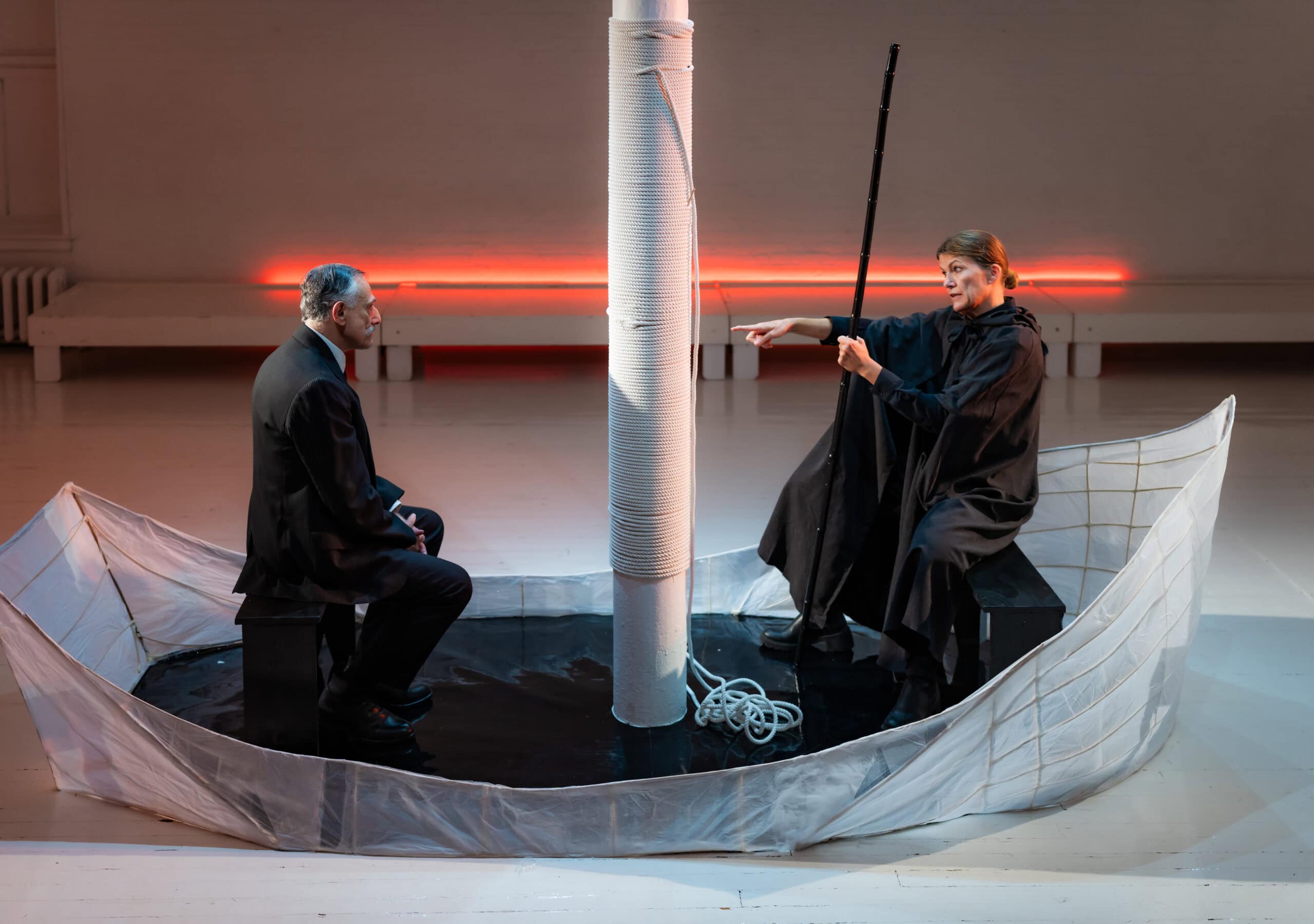
David Greenspan and Annabel Capper in The Invention of Love. Photo: Paul Lutvak
As a teenager, I was enthralled when I read Tom Stoppard’s first play, Rosencrantz and Guildenstern Are Dead (he was twenty[!] when he wrote it). My infatuation deepened when I saw back to back productions of Hapgood and Arcadia in the 1990s. His body of work (including screenplays for classic films such as Brazil and Shakespeare in Love) is breathtaking in its variety, quality, and sheer volume.
It’s also quite challenging. Stoppard’s plays are as verbally dense and complex as Shakespeare’s. In my experience, successful stagings prioritize subtext and emotional throughlines over the intellectual, verbose dialogue. The current production of Stoppard’s 1997 The Invention of Love at Theaterlab has bright spots, but too often director Zachary Elkind’s production floats on the surface, overwhelming and alienating the audience.
Like many of Stoppard’s works, The Invention of Love interweaves seemingly unrelated subjects to great effect. The story follows turn-of-the-(twentieth)-century scholar and poet A. E. Housman (the marvelous David Greenspan) who, at the play’s start, has just died. As Charon (a suitably humorless Annabel Capper) ferries him to Hades, he witnesses scenes from his life, starting when his younger self (Yaron Lotan) meets his object of lifelong unrequited infatuation, fellow Oxford student Moses Jackson (José Espinosa). Unlike his high-visibility, convention-defying queer classmate Oscar Wilde (Sam Bolen), Housman lives in the closet, keeping his desire secret. But over time, Housman transforms (at least professionally) into a Joan of Arc–esque firebrand, vociferously denouncing those who accept and perpetuate corrupted ancient texts with a no-holds-barred academic style that stands out in buttoned-up late-Victorian/early-Edwardian England.
The Invention of Love hasn’t gotten many productions, at least not as many as it deserves, perhaps because it is long, challenging, and largely about textual analysis. This MAP Theater production feels hurried, but when Elkind slows things down in some of the longer, two-person scenes, the play sings, such as when Greenspan, whose commanding, intense presence is almost hypnotic, meets his younger self. Lotan’s awkward, innocent college student is a wonderful counterpoint to Greenspan’s seasoned Housman, so distinct the latter is prompted to declare, “What a strange thing is a young man.” Other shining examples are the scene where young Housman finally admits his love to José Espinosa’s breezily daft Jackson, and when Wilde—a character Sam Bolen brings to wondrous life—finally meets Housman. Housman tells Wilde they were born at the wrong time, when “disavowal and endurance are in honor.” Wilde disagrees; they live in the best time. As for his persecution, he declares, “Better a fallen rocket than never a burst of light.”
But so much of the play feels like recitation. The production loses the import of moments and scenes partly because there are so many of them. Stoppard is a bit of a showoff, producing an overwhelming tsunami of text. Knowing next to nothing about Housman or textual analysis, I felt lost for long stretches, unsure why I was watching the action onstage, or why certain characters were there at all. To compound my perplexity, many of Elkind’s staging choices, such as having four scholars move in a circle with croquet mallets while conversing, eluded me.
Similarly, the design elements left me scratching my head. The set, designed by Bridget Lindsay, bravely attempts to incorporate the structural pillar in the space’s center, but it ends up encouraging stasis. Alyssa Korol has dressed most of the actors in convincing period dress but without shoes. Perhaps this is to keep us from taking the characters seriously. But I suspect the play is more effective if the audience, like Housman, comes to understand the authorities are false gods as the play progresses, rather than in its opening moments. Paige Seber does what she can with limited lights and a ceiling low enough to make one ponder building codes, but the instrument shining in my eye for much of the play was quite distracting.
Whatever my objections, I was happy to get to get to see this Stoppard masterpiece. And it is a masterpiece. The ideas fly by fast and furious, each more interesting than the last, and days later I’m still thinking about it. I hope the play gets another production soon; I can’t wait to see it again.