
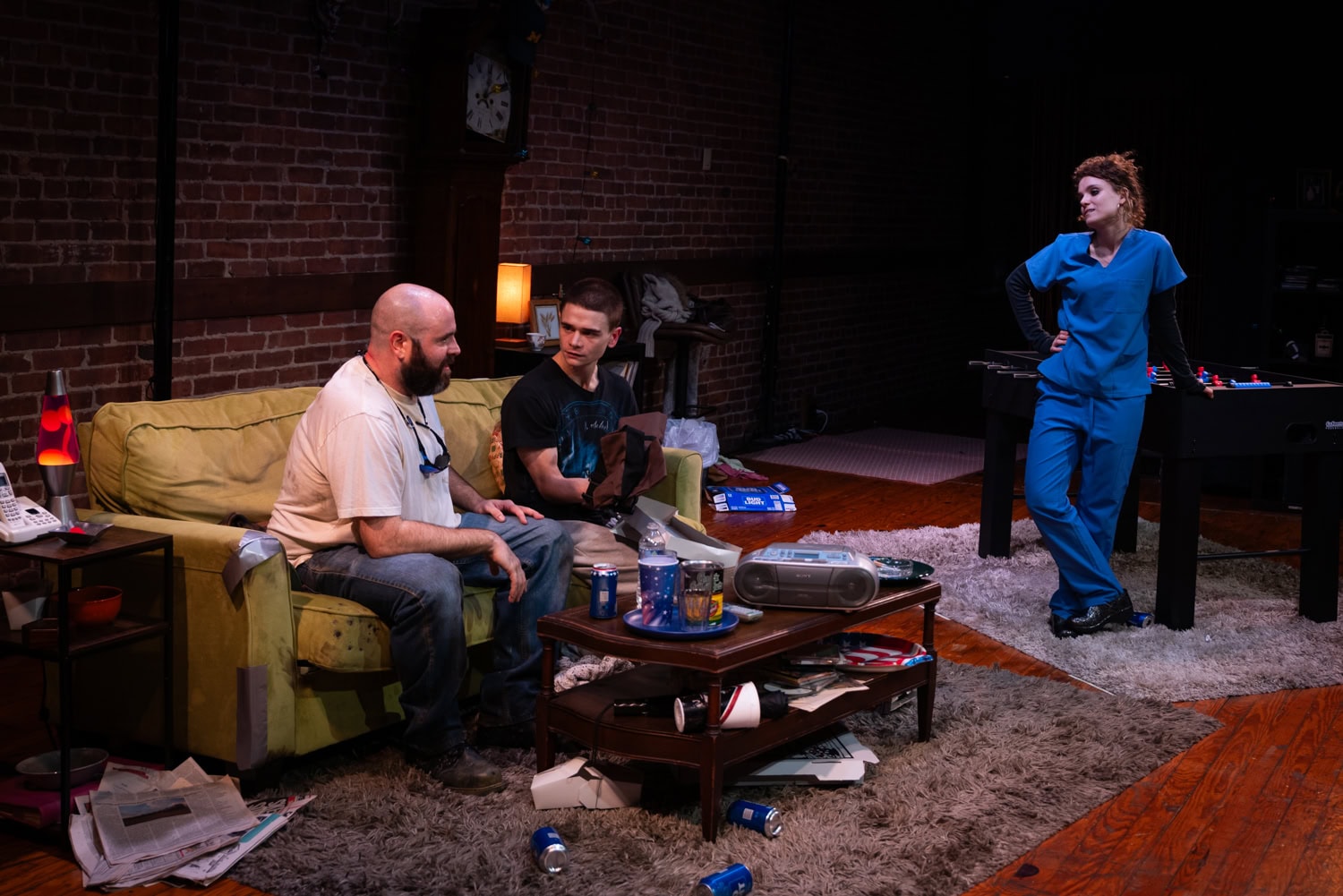
Forrest Malloy, Will Ehren, and Mia Vallet in Foosball. Photo: Jacqueline Silberbush
Classic nineteenth-century realism brought us the principle of Chekhov’s gun: “If in the first act you have hung a pistol on the wall, then in the following one it should be fired.” Foosball, a new play by Sean Czarnecki, directed by Claire Siebers, seems to have Chekhov’s iPhone. Given as a covert (and expensive; it’s brand-new technology at the moment of the play’s setting) sixteenth-birthday gift to JJ (Will Ehren) by his honorary aunt Evelyn (Mia Vallet), it’s meant to remain a secret between them. The ostensible motivation for this secrecy is to allow them to communicate behind the back of Will’s volatile father, Laird (Forrest Malloy).
But the idea that Evie is protecting JJ from an abusive parent only holds up through the first scene; her motives are hardly pure. (Spoiler alert, but it’s hard to talk about Foosball otherwise, since the punches that it packs come almost entirely from the relationship between Evie and JJ, the depths of which are slowly revealed.) Laird is a single dad–JJ’s mom left when he was an infant–who is frequently absent due to his job as a long-distance truck driver. The picture that we’re originally given makes him seem like a brute who can’t imagine his son as anyone other than a capital B Boy who wants a tool belt for a birthday gift, and Evelyn seem like the brave soul who intervenes. But we quickly—and effectively—get that simple opposition muddied. Laird drinks too much, has a temper that can flare into violence, and doesn’t really know his son, yes, but he’s less a monster than a person who doesn’t have the emotional tools to cope with the role he’s been handed. And Evie, far from being the protector of JJ, is herself a predator (who’s apparently been giving Laird some pretty questionable parenting advice).
Evie promptly uses the new iPhone to take intimate photos of her teenaged nephew, and the phone immediately becomes a hot potato that will, of course, end up in the wrong hands. The plot requires this moment of discovery–JJ’s secret; a very explicit and abrupt way for his friend Dani (Alice Jokela), the only girl in the room and the only teenager who’s not super drunk at the time, to find out about it. (And this very specific plot element also oddly dictates the precise moment of the play’s setting: The characters need to have smart or smart-ish phones with enough information on them for this to be an interesting wager and for them to contain high-value secrets, but not advanced enough smartphones that they have password protection or face recognition. And Czarnecki clearly doesn’t want social media to come into the narrative.) This moment is the key connective tissue between Czarnecki’s two strongest scenes–when we the audience realize what is happening between Evie and JJ, and the shattering monologue where JJ tells Dani all about it and in telling it, starts to recognize the events in a different way–but its execution feels contrived and inorganic.
That’s partly due to the way the access to the phone occurs, which is convoluted and involves a foosball match among JJ, Evie, and two of JJ’s friends for reasons that seem to have more to do with Czarnecki’s desire to use foosball as a narrative spine than because it makes sense for the characters involved to mutually share access to their phones as part of a friendly wager. A lot of key moments in Foosball involve foosball, but Czarnecki hangs an awful lot on a symbol that doesn’t feel deep or rich enough to serve that function. It’s a spot for competition between Laird and JJ, sure, but everyone in the room—Evelyn, JJ’s friends Blake (Gideon Klapow) and Ken (Antony “Ant” LoGrande)—gets sucked into playing. And when they do, the action grinds to a halt, as the actors are static and focusing their energy down at the table; it’s an obstacle that Siebers’s generally sensitive direction can’t overcome.
There is genuinely powerful material underlying Foosball, but it’s also surrounded by a lot of this kind of contrivance and environmental detail, rather than solid world-building: the foosball; the focus on the brands of beer that Laird drinks versus what the kids buy; the technical specs of the new iPhone and what you can do with voice recording features. (The actual built environment, designed by Kristen VanDerlyn, is solidly on-point.) But what the play needs is deeper understanding of its own backstory: Certain revelations about JJ’s mom would seem to imply that JJ has never asked about her in the previous sixteen years. Laird is absent for a solid hour in the middle of the play, in favor of a slow build in JJ’s birthday party, when that relationship between JJ and his dad is ultimately a key part of understanding the relationship between Evie and JJ. A story Blake tells about being forced to befriend the “poor kid” doesn’t help us to understand why Blake, Ken, and JJ even are friends. (A sketched romance between rich-kid Blake and hammy theater-kid Ken, while it does give both actors some subtext to maximize, also feels superfluous.)
Siebers has done particularly good work with Ehren and Vallet, whose tangled, charged “us-against-the-world” bond recalls the Todd Haines film May December, but the further layers of dishonesty in Evie’s behavior that are revealed late make her a less complex villain. Foosball needs less foosball and deeper roots.