
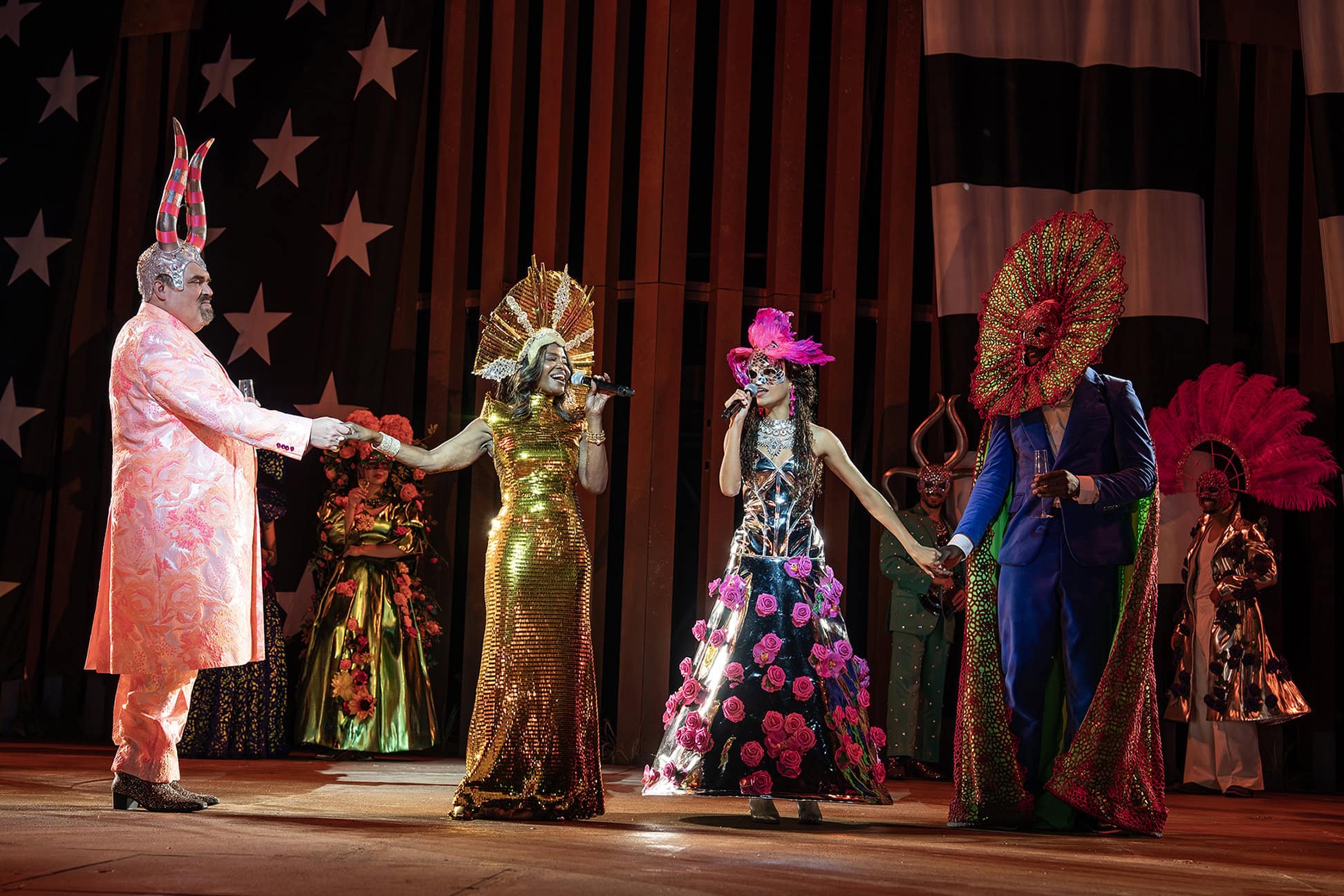
Glenn Flesher, LaChanze, Ra’Mya Latiah Aikens, and Martin K. Lewis in Romeo & Juliet. Photo: Joan Marcus
My love affair with Shakespeare in the Park goes back decades. For a low-income New York City theater kid, the Delacorte Theater was a happy place. I saw Kevin Kline in The Pirates of Penzance and the musical The Mystery of Edmund Drood, and later, when I started working at the Delacorte, I watched every performance of Twelfth Night starring Michelle Pfeiffer, Gregory Hines, and Mary Elizabeth Mastroantonio, among other luminaries. No matter the play, no matter the production, it has always been a pleasure to be at the Delacorte (less so during thundershowers). It still is, though the current show, Romeo and Juliet, is a letdown.
Normally, I’d use this space to summarize the plot, but the story of Romeo and Juliet, so familiar it feels engrained in our collective DNA, hardly needs repeating. Nevertheless: two teenagers from feuding families fall in love, secretly get married, and (I would say it’s a spoiler but it’s literally the first lines of the play) kill themselves rather than live without each other.
Director Saheem Ali has transported the scene from fair Verona to the U.S./Mexico border, where the radical Montagues and the Trumpian Capulets are divided over immigration policy and the young lovers intensify their connection by speaking Spanish when alone. It’s fecund ground, high-concept, and in theory incredibly timely, but the play refuses to map onto Ali’s schema, and I found myself scratching my head throughout the evening.
Though we often think of the play as a dualistic Hatfield-McCoy story, there are actually three parties to the drama: the Montagues, the Capulets, and the state. But here, Prince Escalus (Jessica Pimentel) has no part in the immigration controversy. In what world is the government neutral on immigration, and how should we fear fascism if it is not state-driven? And if the hot potato issue is so central to the families’ feud, why do the anti-immigrant, pro-wall Capulets openly embrace Mexican cultural markers, throwing a showy Day of the Dead ball (highlighting Oana Botez’s imaginative, nearly fluorescent costumes)? And why doesn’t Romeo Montague (Daniel Bravo Hernández) converse with his anti-ICE friends in Spanish like he does with Juliet (Ra’Mya Latiah Aikens)? For that matter, how does Juliet go from learning Spanish in her first scene with Capulet servant Pedro (Marlon Xavier) to miraculous fluency later that day with Romeo?
These philosophical musings might not matter if the production nailed the play’s crucial emotional moments; it does not. I don’t know what Romeo and Juliet see in each other. The moment they meet, the textbook case of love at first sight, flies by almost unnoticed. And the play’s climactic scene, where Tybalt (Ariyan Kassam) kills Mercutio (Caleb Joshua Eberhardt), then dies by Romeo’s hand, is muddled. What makes Mercutio go from preaching peace to waging war? Why is Tybalt going after Romeo’s friend and not Romeo himself? Why is Romeo punished for acting in self-defense? In contrast, Glenn Fleshler’s patriarchally toxic Lord Capulet is loud and clear, and LaChanze gives us a nicely dimensioned Lady Capulet, loving but disconnected from her teenage daughter—and graces us with a beautiful song (credit, too, to composer Michael Thurber). I couldn’t help but think of West Side Story, another immigration-themed adaptation of Romeo and Juliet, which succeeds in part because it is structured around these emotional moments, making them the centerpiece rather than an afterthought.
Audience members with a better grasp of Mexican American social-political discourse may get more out of the show than I did. And those fluent in Spanish might get an extra thrill from hearing the lovers declaim their scenes in that language (making the trenchant point that those from opposing political camps have more in common than they might care to admit). On the other hand, Spanish speakers might be even more bothered by the overacting that accompanies the lovers’ Spanish dialogue, such as when Juliet points to various body parts as she names them.
Aikens does better in English, skillfully balancing Juliet’s innocence and desire. Her unambiguous emotions make Shakespeare’s dense text accessible even when the meaning isn’t immediately clear. Bravo Hernández does less well as Romeo, pining convincingly, but without any spark. Similarly, Eberhardt, giving life to the play’s moral compass Mercutio, hits the mark at times but seems to be hovering around fifty percent in a role that demands one hundred. And Deirdre O’Connell plays the Nurse purely for laughs. At first it’s a welcome respite from the play’s drumbeat of doom, but the one-note take lacks the emotional weight that later scenes require.
There are nice touches throughout the evening. In addition to a convincing re-creation of the border wall, director Ali and scenic designer Maruti Evans provide beautiful imagery throughout: a wildly floral bedspread, a candelabra-filled crypt. The hovering helicopters one always strives to ignore at the Delacorte are cleverly and convincingly coopted by sound designer Mike Tracey. And Christopher Akerlind’s lighting accomplishes the challenging task of directing our attention during the twilight’s ever-changing backdrop.
The Public is finding ways to extend the Delacorte’s plein air aesthetic, incorporating other aspects of New York life into the Shakespeare in the Park experience. At my preview, we were treated to a pre-show, true-life story from a native New Yorker and a pre-curtain call wedding ceremony. Both were fun, though they extended the already long run-time.
Perhaps the most jarring part of the evening is Citizens Bank’s very public sponsorship of Shakespeare in the Park. The financial institution has come under heavy criticism for enabling the for-profit prison industry’s ICE detention centers and is the target of a grassroots pressure campaign to divest from these unsafe, unsanitary, and often inhumane facilities. The contrast between patron and art calls attention to the bank’s garish attempt at whitewashing.
It’s been years since I’ve read or seen Romeo and Juliet and the play hits middle-aged me differently than it did my younger self. Tybalt’s toxic masculinity, the older generation’s terrible parenting, and the state’s ineffectuality all seem more relevant and dangerous, while the play’s resolution, with the parents taking responsibility for their children’s tragic deaths and resolving to amend their ways, seems a suicidee’s fantasy (and indirectly endorses self-harm). In reality, when humans make mistakes we entrench, doubling down in the hope that more of the same will reverse course. What better illustration of this is there than the immigration issue, which populists have used generation after generation as a scapegoat for all social ills, and which the current administration points to as the root of all evil?