
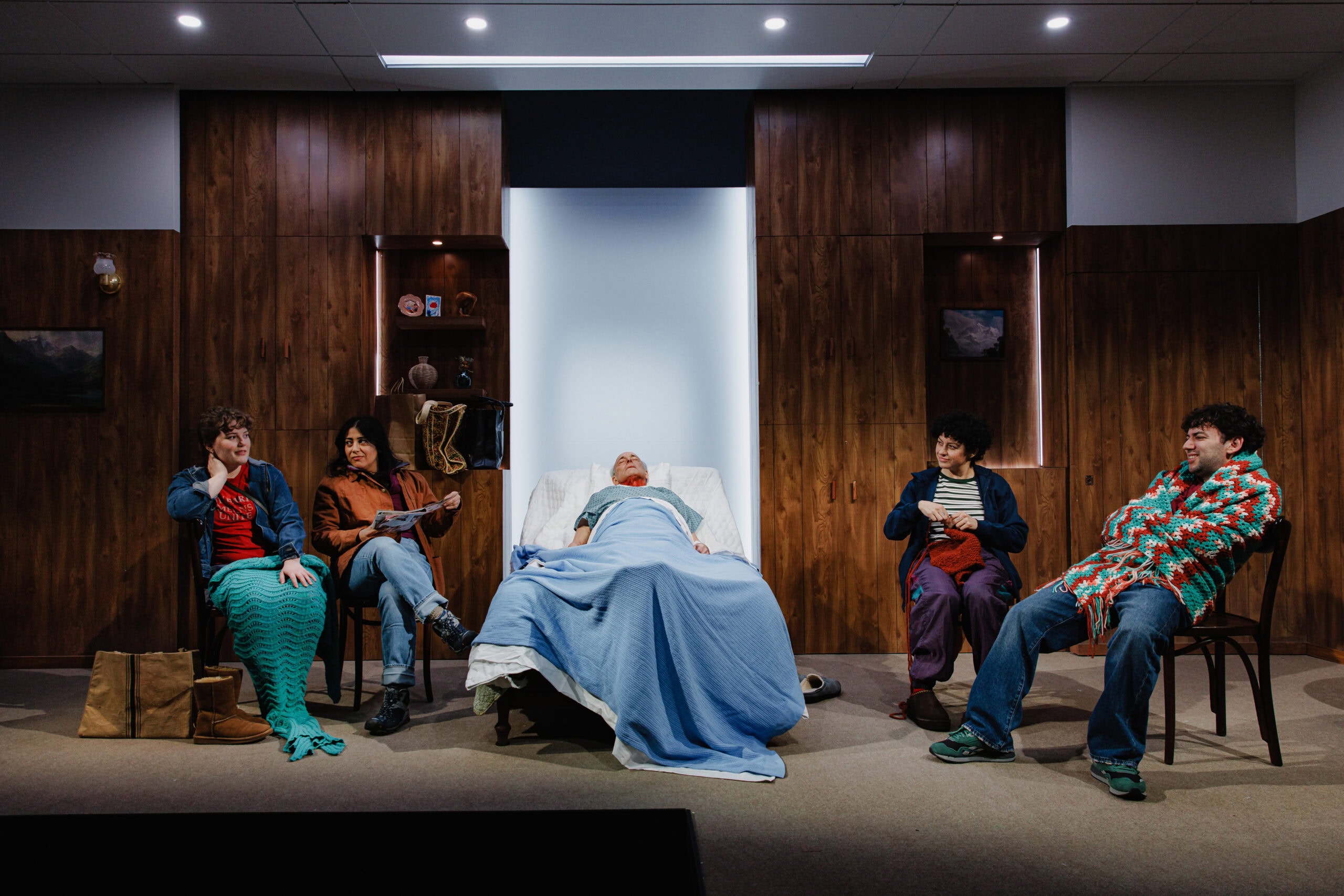
Nina White, Nadine Malouf, Peter Friedman, Alia Shawkat, and Misha Brooks in You Got Older. Photo: Marc J. Franklin
When Clare Barron wrote You Got Older, about ten years ago, she was in the middle of a personal crisis resembling that of the play’s central character, Mae (Alia Shawkat). The play was finished before anything was resolved, Barron writes in a script note, and “it remains a kind of play without perspective.” It’s a play trapped in the middle of something, a play without an arc, and so Barron focuses more on the minutiae of human interactions than on its characters’ interiority or understanding of the place in which they find themselves: there’s no critical distance. We are mired in it with Mae, who’s having the “second worst moment of my life so far.”
She’s just lost both her job and her boyfriend (as can happen when you date your boss). Unemployed and at loose ends, she’s come home to stay with her father (Peter Friedman), the two of them rattling around the big old Washington State house that formerly held a family of six. (Her mom died some years back, and the three other siblings are off living their lives, until–spoiler alert–a family crisis brings them all together.)
Dads and grown daughters: on the one hand, he’s willing to drive her to Seattle to pick up an embarrassing ointment prescription, no questions asked; on the other, he’s going to give her all sorts of well-meaning advice that pushes her buttons, and possibly walk in on her masturbating. More than once. There is plenty of cringe in You Got Older, in other words, and who better to embody that than Shawkat, making a stage debut in a role that makes excellent use of her mobile, micro-emotive face, which feels designed to react to circumstances as they wash over her? Under the direction of Anne Kaufmann, she leans into restlessness and emotional twitchiness; she never feels settled in either mind or body. It’s a good pairing with Friedman’s carefully pitched joviality; he’s a man going through hard things who’s determined to count his blessings, greeting his challenges with rational civility.
It’s not entirely clear at first who’s taking care of whom. Mae is lonely, she’s horny, she doesn’t know what she’s going to do next, and while her dad isn’t quite nagging her about it, he’s already circling toward nagging her, even when she’s just arrived. Shawkat brings a quality of perpetual adolescence (as Ásta Bennie Hostetter’s costumes for her underscore, short shorts and jean jackets), a sense of never quite being definitive about anything, that makes it surprising to find out both that she’s a lawyer and that she’s the sibling who moved the farthest way.
But Dad has cancer—a baffling, widespread cancer finally traced back to his larynx and being treated (just one of many peculiar bodily indignities faced by the characters here). Mae isn’t a natural caretaker–and maybe neither is her dad, which is just one of the ways they’re awkward. But there are so many ways: The way of two people who aren’t used to being alone together. The way of parents and grown children whose lives aren’t working out the way either of them planned. The way of people who hate all their life choices right now (another expertise of Shawkat’s). The way of people who just aren’t very good at expressing themselves emotionally, especially when the stakes are high.
Most of the play is two-person scenes including Mae, the preponderance of them Mae and Dad, and Barron and director Anne Kauffman keep these scenes pretty realist, pretty non-weird (outside of a charming vegetable-garden-on-a-wagon built into Arnulfo Maldonado’s set), pretty much not about anything in particular. It’s a tone of small, crisp intimacies. But then there are the scenes with Mae’s two quasi-love interests (sex interests, anyway), Mac (Caleb Joshua Eberhardt) and Cowboy (Paul Cooper): one a high school classmate of Mae’s older sister, the other a fantasy. Both sneak into her room at night, one in reality and one in fantasy. Both unleash something weirder and more primal in Mae, but in neither case can she get the satisfaction she craves. (The Cowboy scenes are dreamlike, but not quite as theatrically weird as perhaps they could be.)
The play’s long central scene brings in the rest of the family, as Dad gets what’s supposed to be his final cancer treatment. Mae’s siblings, older sister Hannah (Nadine Malouf), youngest sister Jenny (Nina White), and middle brother Matthew (Misha Brooks), arrive en masse, and muddle their way through the appropriate way to behave as they wait for their father to wake up from surgery. Much as Mae reverts to childhood behaviors (down to sneaking boys into her bedroom) when plopped back in her childhood environment, the siblings together bring out all their old patterns: Hannah lording it over them as the most adult of the group, married and with a baby. Jenny whining when she can’t get the “treat” she was promised of ringing the gong that signals successful completion of cancer treatment. Matthew ducking the scrutiny of his gaggle of sisters. It’s sort of charming how non-dysfunctional the family is, and yet they still don’t know quite how to relate or communicate: no perspective. Even though they’ve already lost one parent to cancer, even though Jenny has also been through major heart surgery, they haven’t learned any lessons that will help.
The mortal body will betray you, and as much as anything, You Got Older is about that always-already-decaying human body. Weird physical traits and ailments hover over them all throughout: An extended conversation about the penises of the men in the family. Mae’s got a seeping rash and likes to chew beard hairs. Mac is kind of turned on by pus. Cancer looms all over–not just both Hardy parents but one of Hannah’s ex-boyfriends; she hated him, but she didn’t want him to die of a rare blood cancer. Even Mae’s fantasy cowboy has boils. And then there’s the Hardy family smell, a subject the siblings debate at length around their semi-conscious father. We are trapped in this human form, and no one here seems to have much power over it: even Dad’s “successful” cancer treatment only gets him so far.
But that powerlessness can also be paralyzing: Except for the fantasy cowboy, everyone here seems to react rather than act, which amplifies the play’s lack of perspective. Both in the writing and the directing, the play saves all its biggest emotions for its final few scenes: one blow-up, one breakdown, one eruption of joy. They’ve been a long time coming, which makes them cathartic, but also highlights the syrupy stasis of the rest of the piece. Its observations are sharp and its characters wryly sympathetic, but there’s a little too much wheel-spinning throughout.