
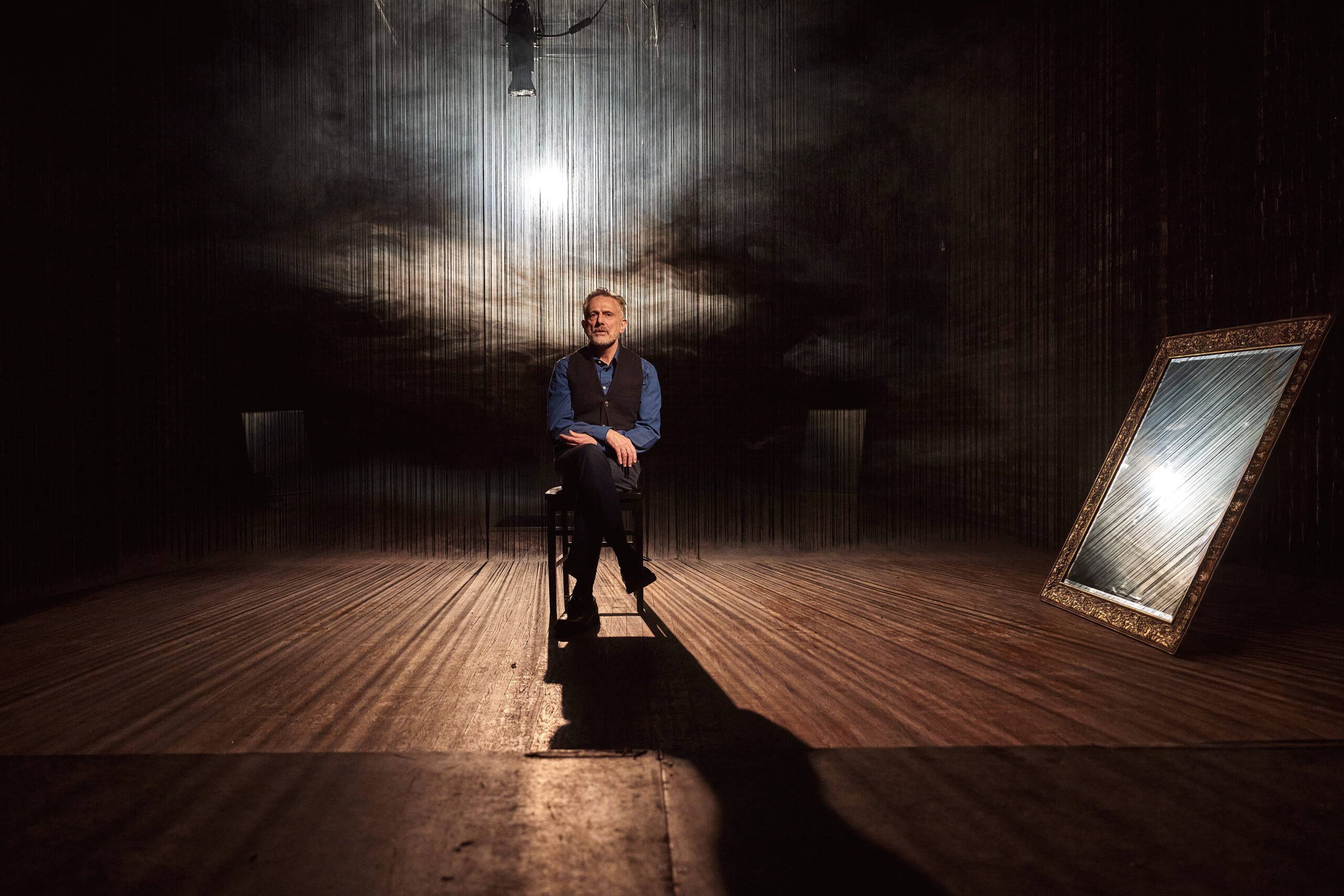
David Greenspan in without mirrors. Photo: Valerie Terranova
without mirrors feels like a throwback to the downtown scene of my theatrical youth: Short on narrative, long on dizzying, unspooling sentences. Intentionally resistant to linear understanding, but with spiky nuggets of idea poking out as you turn it over in your mind. Holding itself and the audience suspended in some sort of liminal state where your backbrain finds meaning in things your thinking brain finds opaque or incomprehensible. Len Jenkin and Mac Wellman and Richard Maxwell and Maria Irene Fornes at Soho Rep; Richard Foreman still running the Ontological-Hysteric. I wasn’t a critic yet; no one expected me to explain anything I was seeing–which was good, because a lot of the time I couldn’t, even, or especially, when I felt like the experience had opened a trap door in my brain.
Owing something, in roughly chronological order, to Beckett’s elliptical monologues and to Gertrude Stein’s sly theatricality; to the language poets; and no doubt to Wellman and Erin Courtney, who run the Brooklyn College MFA program where they studied, Jerry Lieblich, who wrote and directed without mirrors, now playing at the Brick, feels like an inheritor of that tradition, bringing it into our social-media-saturated, overly networked age: “without mirrors, what unfollows what”? Foreman’s What to Wear from a few weeks ago at BAM is the maximalist version of the aesthetic, full of riotous color, a cast of a dozen, and props galore. without mirrors is austere and minimalist: one actor, one chair, two black fringe curtains, and—title notwithstanding—several mirrors. (“Without,” the text reminds us, has both a prepositional and an adverbial sense—not only lacking mirrors, but outside of them.) Kate McGee’s lighting fills the space with stark shadows and dark pools. She also cleverly builds the reflections off those mirrors (she also designed the set) into the lighting design, and likewise, later in the play when the space fills with mist, lights the mist expressionistically. Johnny Gasper’s sound design is similarly stark: mostly attenuated, barely there, except in one big gesture where it overwhelms.
It’s a piece of musing intimacy, a shout into the void in an attempt to find oneself there, divorced from the social web of connections in which we spend our days. It’s a piece steeped in fear and grief, without ever really speaking explicitly of either.
Its speaker is (metaphorically, but maybe a tiny bit literally) alone in a cave, and the play opens–mirrors, remember–with an anecdote about a man rescued from a cave, because his rescuers heard him clanging rocks together. But he did this not to be rescued but to locate himself in the immense black solitude: to prove he was alive. Here, the monologue is punctuated by vocalized “clangs” that are its structural scaffolding. In a sense, that’s what without mirrors is: an hourlong exercise in proving oneself alive without external stimulus to count on; an exercise in, over and over again, repudiating the social gesture and turning within.
It’s a spiraling, often repetitive, often self-negating gush of language, and in the hands of less subtle direction or performance, could easily wear out its welcome after only a few turns of the spiral. But Lieblich is wise enough both to resist the impulse to inflate the piece by going bigger or broader and, perhaps above all, to cast David Greenspan, master of the monologue. If his Four Saints in Three Acts (a recognizable antecedent) or I’m Assuming You Know David Greenspan gave him playing fields of characters to limn with his trademark linguistic precision, here he has only language and only the self-reflecting person of themself, a genderless narrator who is and is not congruent with the playwright.
Even the wry lightness with which Greenspan approaches most roles—a kind of delight he shares with the audience—is stripped away. He’s as grave and contained as the ambience, though dressed with just a hint of fussiness. (We hear the echoes of that fussiness in one of the few exchanges of “dialogue,” a facetious and flirtatious party exchange.) He sits in a chair and gives each word—even, sometimes, each breath, in patterned triads—measured, precise consideration.
This speaker can be nothing but solipsistic–they are thrown back only on their own resources. “I thought I had potential, once. Thought that I could build an edifice of selfhood on potential, promise.” Without mirrors chips away, bit by bit, at that edifice of selfhood. Sometimes it feels like nothing more than a firehose of words–expertly spoken, but ultimately meaningless. Sometimes it feels like a glimpse into the abyss of what humanity has become–an exploration of the absence of the soul.