
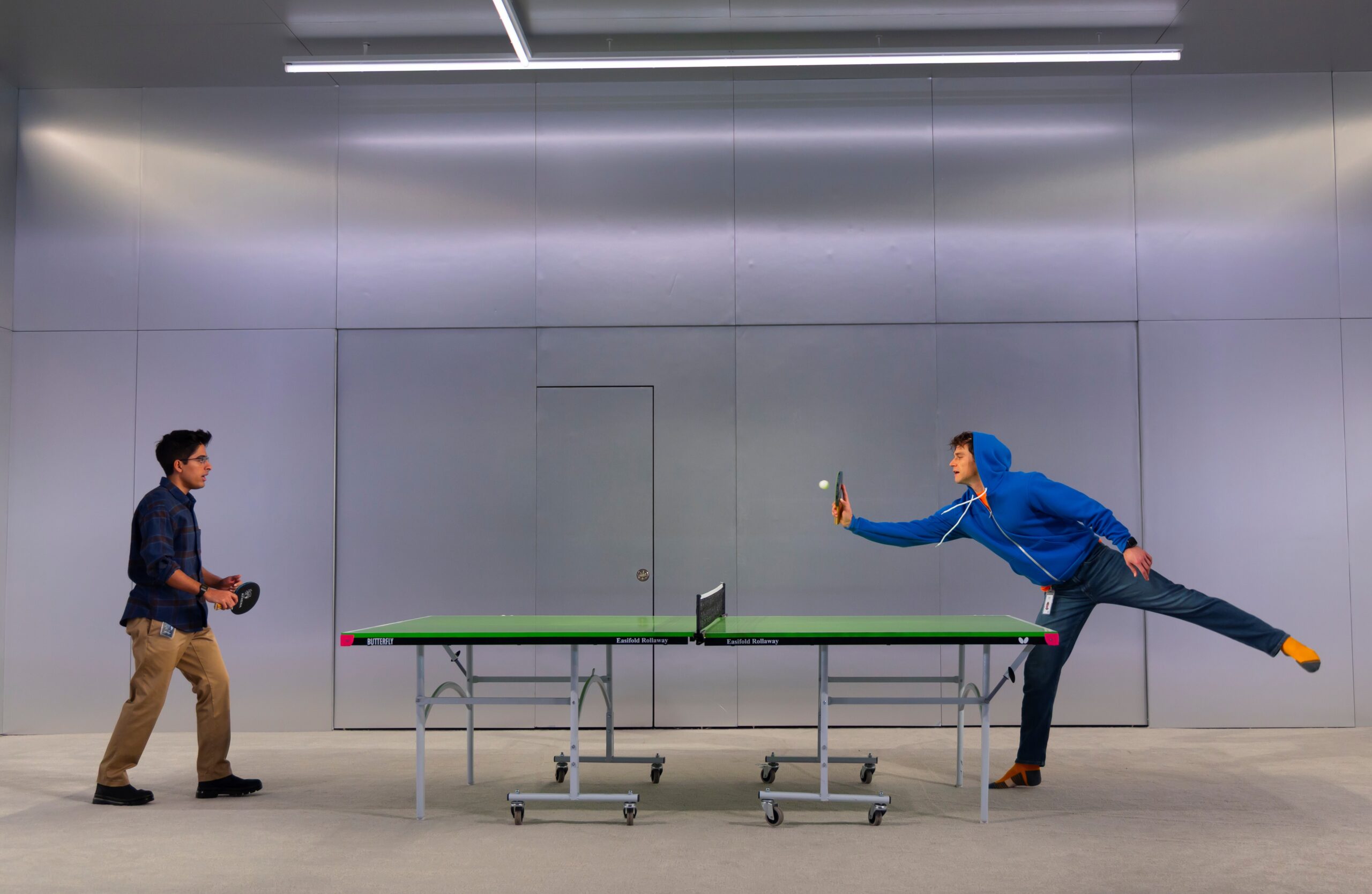
Karan Brar and Brandon Flynn in Data. Photo: T. Charles Erickson
There’s an old theater adage about how you shouldn’t work with kids or animals. After seeing Data at the Lucille Lortel, I’d like to add “table tennis” to the list. The play starts with Maneesh (Karan Brar) and Jonah (Brandon Flynn) hitting a ping pong ball back and forth. These two characters would undoubtedly be playing competitively, but the actors are concentrating so intently on the gentle volley that they can barely recite their lines. What must have looked good on paper comes off as an unreal, indulgent, distracting acting exercise. It is, unfortunately, a harbinger of things to come.
The plot of Matthew Libby’s play concerns Maneesh, a brilliant, underutilized programmer, who has decided not to release the killer algorithm he created lest it be used for evil. When Maneesh is transferred by his tech guru boss Alex (Justin H. Min) to their company’s top secret project, he’s horrified to learn he now must help automate the Department of Homeland Security’s citizenship application process. Disaffected coworker Riley (Sophia Lillis), so angry about goings-on that water glasses are shattering in her hand, wants his help as a whistleblower. Maneesh has to decide if he should risk it all to do the right thing.
To its credit, Data tackles extremely topical and important questions about immigration policy and AI. But its conversation about automating naturalization decisions is so one-sided as to render meaningless any ethics debate, making it the pretext for action rather than something the viewer must interrogate critically. It’s as if we who are watching cannot be trusted to come to our own conclusions.
In fact, time after time, Libby’s and director Tyne Rafaeli’s choices betray a distrust of the audience. Exposition abounds—two unneeded extended scenes of characters on one-way phone calls bog down the action. Other times, artistic choices are hit so hard and so often that it feels pugilistic. Jonah’s outfits, for instance, may tell the story of his transformation from outsider to company man, but they start from a place so over the top that it’s as if costume designer Enver Chakartash is yelling at us to make sure we get it. Ditto the scene changes and accompanying loud interstitial EDM music, composed by Daniel Kluger. The first time the panel of lights around the proscenium disguises a set change, it’s very cool. The fourth time, it starts to wear thin. By the twelfth time, I wanted to close my eyes and stop up my ears.
The performers are all obviously talented. The first scene between Maneesh and Alex, a great exploration of a shifting power dynamic, pairs Karan Brar’s nervous earnestness with Justin H. Min’s convincingly calm, uber-powerful tech guru. But again, the creative team has so little confidence in viewers; there’s little subtext, no grey area. It couldn’t be any more obvious that Min is the villain if he were rubbing his hands together and twirling a black waxed mustache. Sophia Lillis as Riley is called upon to use her considerable emoting skills early in the play, but her supersize reactions midway through leave her nowhere to go, making her grounded performance feel too much. Brandon Flynn as tech-bro Jonah does well early on, but director Rafaeli insists on excess. In a particularly cringey scene, Jonah encroaches on his female colleague Riley’s physical space. That it’s realistic is beside the point—it gives such an ick one can’t help but detest the character after that. For the remainder of the play, his presence on stage is as distracting as the ping pong ball.
When I’m watching something that underestimates my intelligence, I get bored. So it doesn’t matter that Rafaeli uses Marsha Ginsberg’s bold-colored open set and Amith Chandrashaker’s evocative lighting to create striking mises-en-scène, or that the scary phrase “positive and productive addition to America and its values” could have been taken from a real government website. In the end, Data demands little from those watching and offers little in return.