
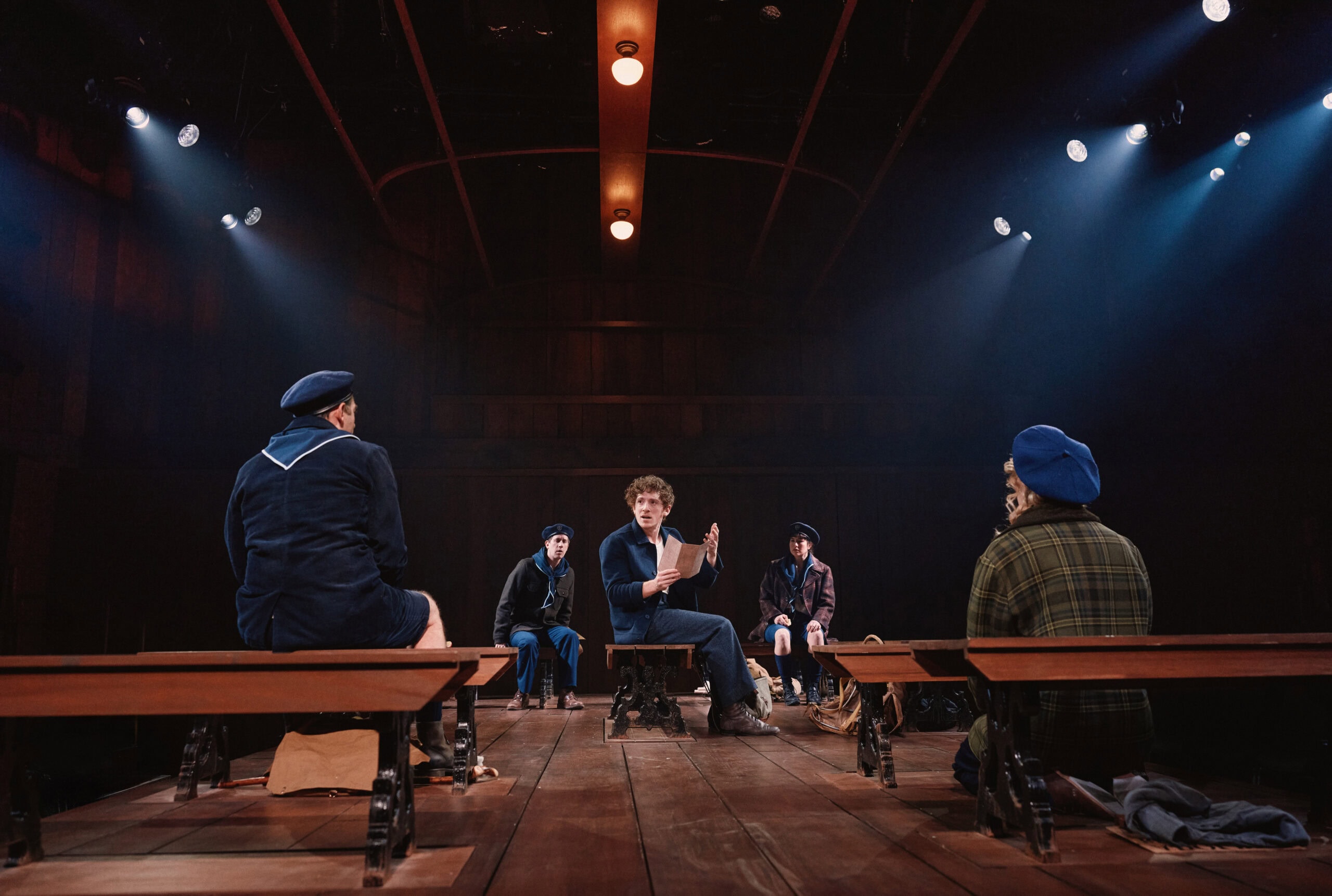
Max Gordon Moore, Alex Wyse, Ethan Slater, Tedra Millan, and Maddie Corman in Marcel on the Train. Photo: Emilio Madrid
No doubt you’ve heard of Marcel Marceau (1923–2007), the mime artist of international fame who graced world stages (including Broadway, twice) for decades as the clownish tragicomic character Bip. What you may not know, however, is that he played another, altogether different role, one of heroic historical significance. Born a French Jew, he was recruited by his cousin to join the French Resistance as part of the Oeuvre de Secours aux Enfants, a relief group that smuggled Jewish children out of Nazi-occupied France. Marceau saved the lives of seventy children hiding in a French orphanage, personally leading them across the border.
Credit goes to actor Ethan Slater and director Marshall Pailet for bringing this remarkable story to dramatic life. Marcel on the Train, their co-authored play now running at Classic Stage Company, tells the true story of the train ride Marceau took with this group of children, bringing them to safety in neutral Switzerland.
Marceau (played by Slater) introduces himself and the play with a series of mime routines on an empty stage. Following this overture, several wooden benches rise magically from the bare floor, representing seats in a train car. A group of children (played by four adult actors) enters and the story of their journey begins. All the details are conveyed with historical accuracy: how they dressed as Boy Scouts; how Marceau hid the children’s identity papers in sandwiches smeared with mayonnaise. (The Resistance leaders thought that Nazi soldiers would not search through oily food for fear of staining their uniforms.)
During the journey, Marceau converses with the frightened children, entertaining them with physical antics and calming them when the train suddenly stops and there is the danger of a search. In the play’s most threatening scene, a sixth actor (Aaron Serotsky), playing a German officer, begins to interrogate Marceau and the traumatized children. Marceau attempts to distract the officer with humor while he searches through their belongings. “Lying takes practice, and children have to have enough time to learn,” the officer responds menacingly, but he leaves and their journey continues.
Serotsky plays multiple roles, including Marceau’s father, who appears in his memory (he died in Auschwitz in 1944), and Georges, the cousin who recruited him into the French Resistance. (Like Marceau, Georges Loinger was a hero, saving the lives of 350 Jewish children.) This double-casting device constantly reminds us that this is a historical story of broader implications. (One scene, featuring a flash-forward to one of the children on the train, who decades later fights in the Vietnam War, was a jarring, unnecessary interruption. Still, it reveals the co-authors’ conscientious effort to stress the broader significance of the story they are telling.)
Scott Davis’s spare scenic design and Studio Luna’s striking lighting serve the story well, as does Marshall Pailet’s clear direction. As Marcel Marceau, Ethan Slater—a skilled comedic actor, best known for SpongeBob SquarePants: A Broadway Musical and the Wicked movies—displays considerable physical talents. At the story’s conclusion, a sign appears on stage, announcing that Bip (Marceau’s stage persona) will appear in a mimed coda about chasing butterflies. This time, Slater smears clown makeup on his face, as Marceau did in performance. He’s joined by one of the children, Berthe (Tedra Millan), now an adult, who mimes along with him. Thus, the play begins and ends with a silent tribute to the man, his art, his legacy, and his unknown story.
Curiously—and I’m still not sure why—Marcel on the Train did not have same emotional impact on me as did Life Is Beautiful, Roberto Benigni’s deeply moving 1997 film that also used humor to depict the Nazi nightmare. Perhaps it’s because we are not used to the sound of silence on stage: the only sound the art form of mime can produce. Co-authors Slater and Pailet remind us that silence can speak louder than words, especially in the telling of a phenomenal story like this one.