
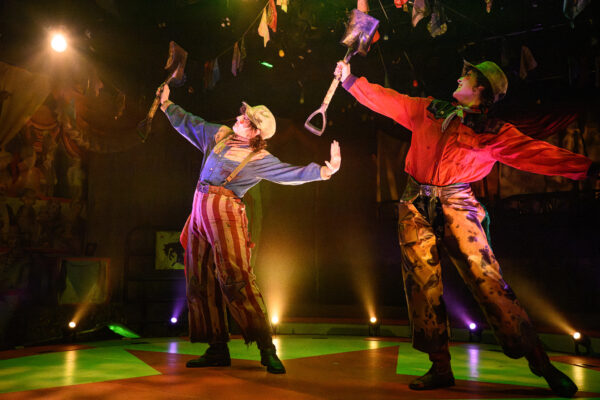
Xhloe and Natasha in And Then The Rodeo Burned Down (Photo: Ben Arons)
From the start, there was a mysterious tension underlying physical theater duo Xhloe and Natasha’s show And Then The Rodeo Burned Down.
Ars Nova has been transformed into a something of a patchwork circus tent, covered with stars and draped in garlands of bandanas. On a round stage, with hidden doors, Xhloe and Natasha are donning clown make-up to the sound of Dolly Parton’s “9 to 5.”
Despite their white-faced, red-cheeked clown smiles, something was not as it seemed. Throughout their synchronous movement, a pep in their step, and comedic pratfalls, an eerie dissonance rose to the surface.
It’s what makes the show deeper than a straight plot explanation might suggest. It has the dramaturgy of something richer.
On some level, it does involve Dale (Xhloe Rice), a rodeo clown aspiring to be a cowboy. Dale encounters his troublemaking shadow Dilly (Natasha Roland), who mimics Dale but also questions the things Dale takes for granted and plants seeds of doubt and maybe desire in Dale’s mind.
Dale is taunted by the brutish Barnaby the Cowboy (Roland), who dangles the chance to become a cowboy in front of Dale but is never sincere about the offer. And then the rodeo burns down? Or does it?
On another level, the show is about making art, depleted funding, meta storytelling, identity, anxiety, desire, strength, love, the traps we find ourselves in in life and the way out.
It might sound like a lot for a 70 minute show. But it’s not trying to solve all the questions it asks. Rather than overburden the story, it opens up all these cabinet doors of possibility. So as the audience we get to poke around in these ideas. The show buzzes with a frenetic energy but leaves us with a lingering sense of thoughtful introspection.
With musical interludes, the sound of a roaring blaze, and an inordinate amount of cigarettes it playfully taunts the audience with its ideas.
I tend to struggle with clowning as a baseline, but the storytelling approach and interrogation of happiness, disappointment, self-perception and self-delusion appealed to me more than the pratfalls.
Xhloe and Natasha are strong physical performers and will deliver on the clowning for folks who enjoy that. But what struck me most was the writing. It mirrors the stage movement. Unexpected twists, laughs, and rhythmic repetition is built into the architecture of the show.
Like the Wizard of Oz’s Scarecrow with a sharper edge, Roland plays the empty-headed but opinionated Dilly with a dangerous unpredictability. We are never quite sure which way things are going. As counterpoint, Rice is the gullible Dale who wants to believe his fate is about to change, but there is distress in his eyes despite arguing to the contrary.
Through costume design, the characters flip in an instant. With a horned cap and a piebald jacket, Roland becomes the rodeo bull Arnold. Covering her grimy rodeo clown gear (suspenders, bandanas, and chaps) with a bright Lily Pulitzer-esque pink and green cowboy hat and jacket turns Roland into the arrogant cowpoke with a chip on his shoulder. The sound design hints at the rodeo audience somewhere in the distance and the rumble and crackle of the fire.
The show balances a scrappiness with inventiveness and a dinginess with something magical. It is full of blossoming discovery.