
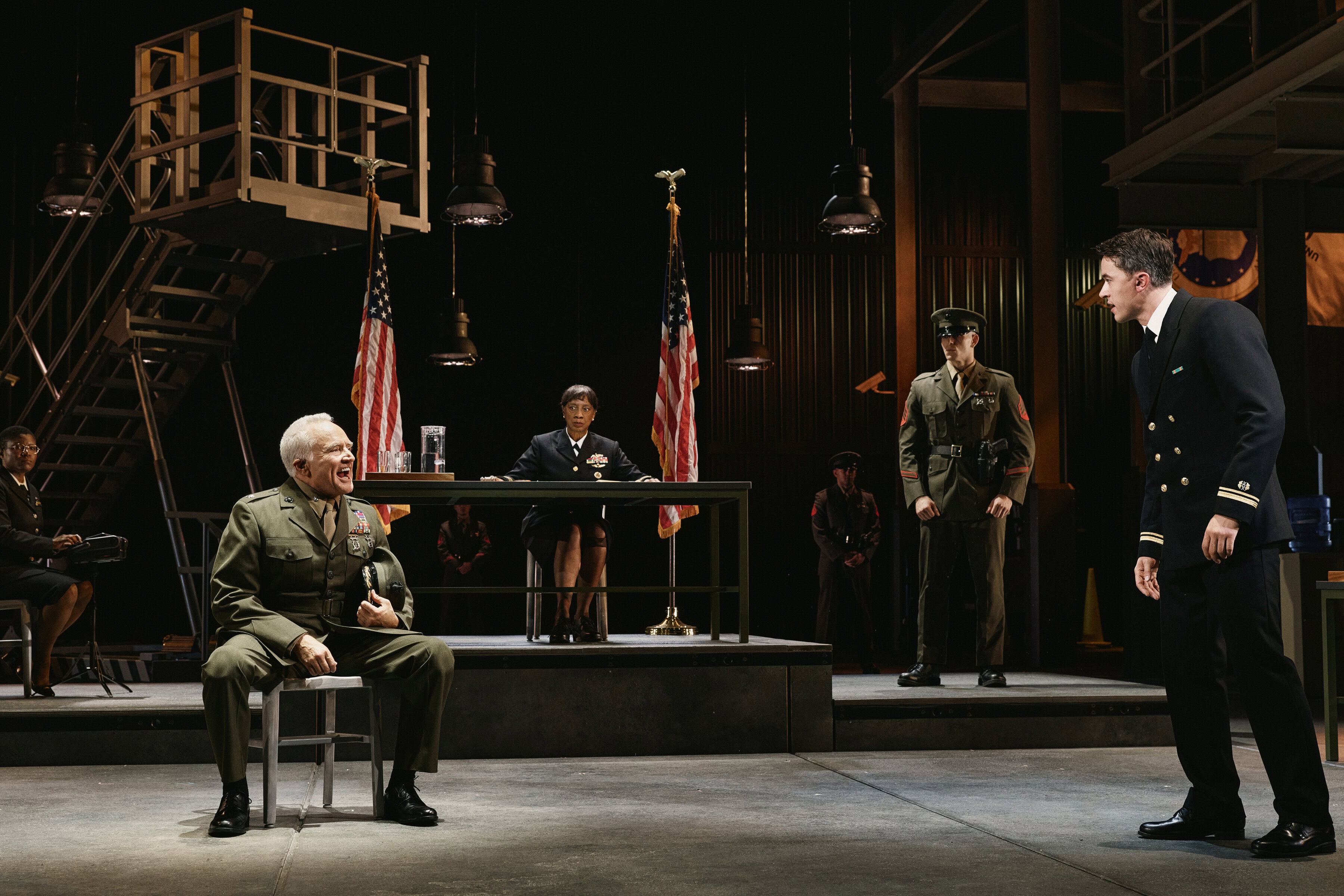
“A Few Good Men” at the Vivian Beaumont Theater (Photo: Emilio Madrid)
Lincoln Center Theater’s Broadway revival of A Few Good Men comes at a crucial time in Aaron Sorkin’s career. The original production in 1989 launched Sorkin into the upper echelon of American screenwriters, a position he held on television and in film for decades. But with last month’s release of his latest movie, The Social Reckoning, an unsuccessful sequel to his crowning masterpiece, The Social Network, his engine is sputtering. Luckily, this large-scale revival has pulled up to put some gas in his tank.
It’s amazing how much of Sorkin’s style is already present in one of his earliest pieces of writing. Sorkin’s dialogue bounces from character to character, clearly inspired by David Mamet’s work in the preceding decade-plus. But where Mamet sometimes relies on a brutality of language, Sorkin’s verbal sparring has a lighter touch and is more about an intellectual exchange of ideas. While Sorkin’s writing has recently turned toward liberal indignation, Mamet’s ideology is best left undiscussed, but you can feel Sorkin’s late-twenties fingers finding that magical groove in the dialogue.
But there’s the issue of Joanne Galloway: the first in a long line of capable, professional Sorkin women who aren’t taken seriously by the men around them, or by the author himself. From A Few Good Men’s Galloway all the way to Frances Haugen in The Social Reckoning, Sorkin has this idea that a woman who is great at her job needs to be ridiculed and demeaned by the men around her. It’s as if being this kind of woman comes at a necessary cost – public humiliation. Krysta Rodriguez does her best to register Galloway’s frustration, but without any opportunity in the play to verbalize it, she just takes her beatings and the play trudges on.
Director Michael Arden and scenic designer Dane Laffrey set the production inside an enormous hangar, making full use of the Vivian Beaumont’s massive stage. Though much of the play consists of groups of people talking in a room, the vastness around the characters and a glass-enclosed control office looming above the stage give the impression that the mechanism surrounding them is much greater, and more powerful, than their individual decisions.
Composer Gabriel Mann punctuates the scenes with regal music, giving the play the feel of an episode of Sorkin’s The West Wing. It’s smart of Arden and Mann to lean into this recognizable aesthetic. Sorkin’s best work is situated in Clintonian optimism and the strains of Mann’s incidental music have a yearning for a lost Americana.
As Lieutenant Kaffee, Tom Blyth has a natural swagger and an imposing frame. He enters the room bravado-first. There’s an air of privilege about him, that his good looks and confidence have won him his cases – and whatever else he wanted – his whole life. Blyth, known exclusively for his film work, trained at Juilliard and has a natural stage presence. He carries the play easily, but some of the Sorkinese gets lost in his American accent.
Of course, longtime Sorkin collaborator Bradley Whitford excels at it. Whitford has such a strong command over Sorkin’s words that he doesn’t need to speed through it like so many actors before him. Taking on the iconic role of you-can’t-hand-the-truth Colonel Jessep (played in the film by Jack Nicholson), Whitford has a relaxed sort of southern gentleman take on the role, like he’ll offer you a julep on the front porch while the KKK is in the backyard hanging a noose. It’s chilling and highly effective. Don’t get left alone in a room with that guy.
Nick Blaemire, as Kaffee’s right hand man, Sam Weinberg, is a necessary foil and Blaemire slips smoothly into his own Sorkin archetype: think John Gallagher, Jr. in The Newsroom or Whitford on The West Wing. Weinberg is barely acknowledged for his contributions in the play, but Blaemire makes a strong impression, even in Blyth’s shadow. On the flip side, John Zdrojeski’s fiery Kendrick blasts his way through every scene, delivering the intensity that Whitford’s Colonel Jessep reserves, and he is equally as terrifying.
Sorkin’s adaptation of To Kill a Mockingbird was a smash on Broadway for several years, but perhaps it’s time for him to come back to the stage with a new, original play. His dialogue’s been discussed, but it’s no surprise to anyone familiar with his work that he also has great skill in plotting and using turns of story to keep an audience invested. Maybe at this point in his career, sparing us his cinema and returning to his roots would be a wise decision.