
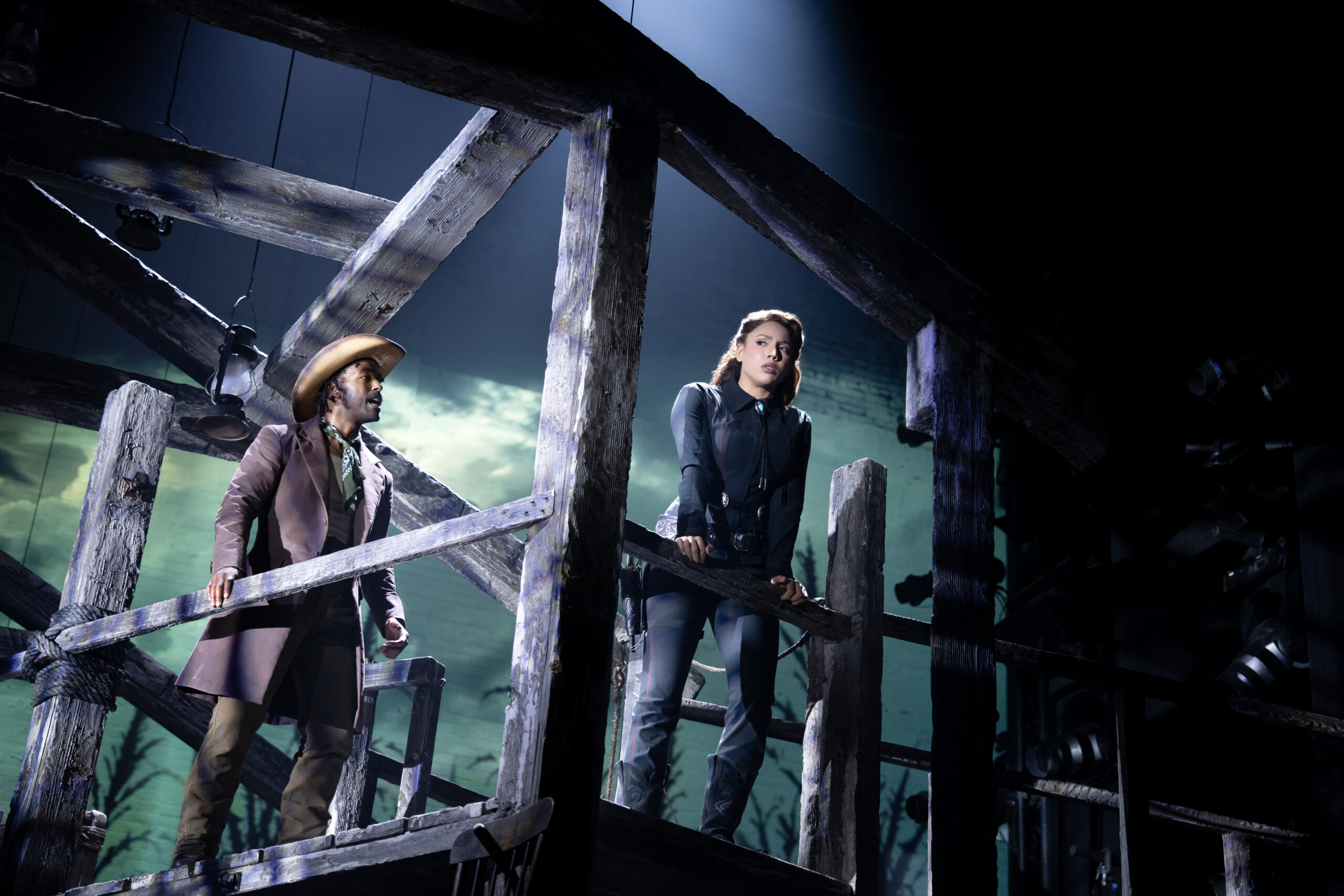
Luke James and Liisi LaFontaine in Wanted. Photo: Julieta Cervantes
On the hottest days of my infancy, my mother would seek relief in New York’s second-run movie houses, watching countless low-budget Westerns (and their brothers-from-another-mother, martial arts Easterns). Though the details changed, the formula was consistent: a good guy (always a guy), facing seemingly insurmountable odds, triumphs against evildoers. The new Broadway musical Wanted strays from the Western playbook by giving us wrong-side-of-the-law, African American (singing) heroines. Unfortunately, despite ace-high design elements and crack vocal performances, buffaloed storytelling ambushes the production while sap-headed video projection shoots it in the back.
The story, which is “mostly true” according to the fantastic Greek chorus of Kinfolk that opens the show, follows sisters Mary (Solea Pfeiffer) and Martha Clarke (Liisi LaFontaine), light-skinned Black women in the post-Reconstruction South who pass as white, go on a crime spree, and mete out justice to racist white Southerners. Having stolen enough money to pay off the unjust debts of their mother, Tallulah (normally played by Ledisi but ably covered by understudy Jennie Harney-Fleming in the performance I attended), the sisters are derailed at a bar where Mary falls for the rich white Jesse (Bradley Jaden) and Martha for the poor Black Elijah (Luke James). Mary hides her Blackness to be with Jesse while Martha yearns to admit hers to be with Elijah (and also wants to get back home to save their mama).
Angelica Chéri, who wrote the book and lyrics and, as she tells us in the pre-show announcement, is a relative of Wanted’s sister-heroines, dispenses with the outlaw portion of the show early on, in the song “Gun & Powder” (the show’s original title). Instead, she lingers on the more conventional, less interesting love stories. It’s kind of a reversion to the mean, making this show like every other.
To make matters worse, Chéri consistently refuses to make specific choices. In “Invisible,” Elijah sings (and boy, does he! Luke James’s tremendous vocal talent is a showstopper) about falling in love, “There’s something about her.” But what? All I heard Martha say was, “You know you was made for somethin’ bigger than all this.” Which can be said of anyone, really. Mary and Jesse’s duet, “Sanctuary,” boils down to the idea that being loved is wonderful. Said every person everywhere. Later, former slave Flo (Awa Sal Secka) says of her enslaver, “He broke up our families.” Was she taken from a parent? Did she lose a child? These generalities produce generic characters and rob Wanted of emotional impact.
Plotting is an even bigger issue, so MASSIVE SPOILER ALERT. A jumble of confusing twists (Why does Martha shoot Jesse? And from where? And how does she get away?) that go nowhere (The bullet turns out to have barely grazed his leg) and defy credibility (Why is Jesse unconscious and thought to be close to death? And how do all the Black characters know it was Martha while the white ones remain clueless?) make the second act implausible and unbearable. Bigger spoiler alert: The show’s huge revelation hinges on a character’s surprise that the wealth of a rich white Civil-War-era Southerner comes from slavery. If there’s any surprise, it’s that Jesse is old enough to have owned slaves, given that the action is set some thirty years after the Civil War. For another example: The show starts with the Clarkes trying to buy land that “our kin folk paid for… with their blood and sweat,” from the mustache-twirlingly evil Mr. Billingsley, only to have him steal their money and declare them impossibly deep in debt–completely plausible. But why should we or the Clarke twins believe that their mission to get more money and buy the land will result in a different outcome? The list of nonsensicals goes on.
Book aside, there is plenty to celebrate. Ross Baum delivers a bouncy and varied gospel/jazz score. Solea Pfeiffer is versatile and powerful as Mary, soaring in songs like “The Way I Am” and “Real Woman.” Not only do the six members of the truly great Kinfolk chorus sing unreasonably well but they act well, too; Chéri and director Stevie Walker-Webb individuate each member, allowing them to comment on the action throughout. Also commenting are maids Sissy and Flo; Secka and Aurelia Williams deftly provide comic relief. Liisi LaFontaine, who plays Martha, is not as strong a singer, and I found myself struggling to understand her lyrics and the emotions behind them (though she was convincing at other times).
Beowulf Boritt’s set is imaginative, evocative, and versatile, and combined with Adam Honoré’s wonderful lighting and Gareth Owen’s soundscape, strikes a great balance, suggesting each location without imposing limits. The change between the first setup, a barn, and the second, a moving train, is creative and exciting (credit also to Walker-Webb and choreographer Chelsey Arce, as well as the cast, for making the train so much fun). Likewise, the costumes, designed by Emilio Sosa, enhance the action, calling attention to themselves when appropriate and to Messrs. James and Jaden’s sculpted abs at other times.
Design-wise, the problem is the heavy-handed, completely unnecessary projections. I can’t blame designer Stefania Bulbarella; the fault lies in the decision to have projections at all. They’re distracting and infantilizing, as if the audience can’t be trusted to watch a musical without a kinetic, AI-generated, 1980s music-video backdrop. Clumsy and often incredibly cheesy, the projections turn what might have been enjoyable songs into cringy experiences.
I’m always aware that my background and history affect how I take in a show, and that’s definitely a factor here. Wanted offers Black female protagonists (and creatives), still too rare in commercial theater, and I, a jaded older white guy, might well have reacted differently if my demographic profile was other than what it is. Not to say I would have liked Wanted (the projections would have driven me crazy regardless), but I might have appreciated some aspects more. I’m happy that a show about two badass women got made. I just wish it had been made better.