
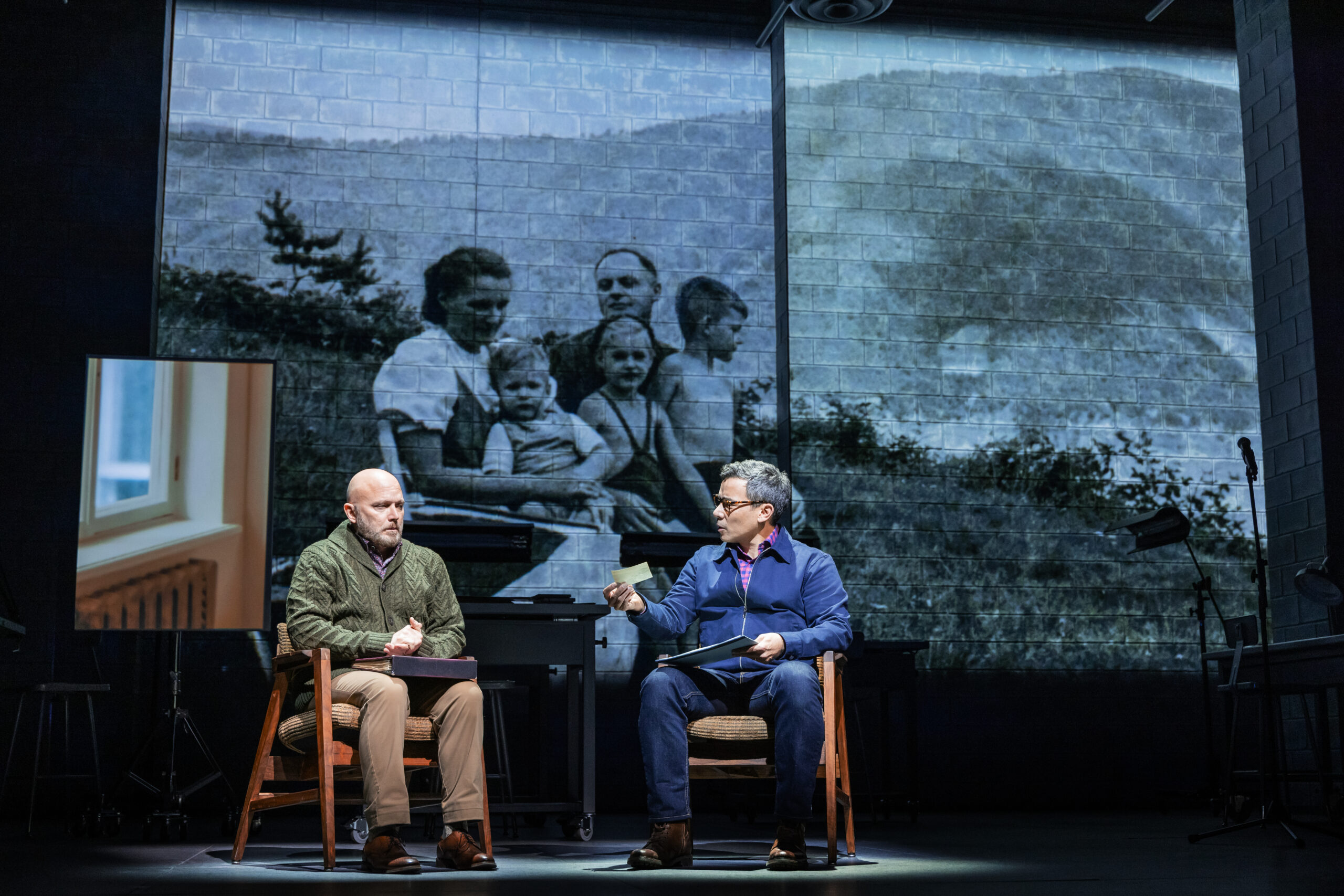
Michael Cerveris and Conrad Ricamora in Here There Are Blueberries. Photo: Matthew Murphy
In the decades following the Holocaust, the theatre has responded to its horrors with a series of powerful, memorable plays—from The Diary of Anne Frank to Tom Stoppard’s recent semi-autobiographical Leopoldstadt. These plays have focused on its tragic victims—namely Jewish individuals, families, and their future generations. But now we have a new play that looks at the Holocaust through a shocking and unexpected perspective—that of the perpetrators.
Now playing on Broadway, Here Are Blueberries, the astonishing docudrama conceived and directed by Moisés Kaufman of Tectonic Theatre Project (and written by Kaufman and Amanda Gronich), deals with the discovery of a photo album donated to the United States Holocaust Memorial Museum in 2007. It contained 116 photos featuring the daily life of the Germans who ran Auschwitz: military, medical, and secretarial staff, photographed at routine gatherings, meals, and leisure time. The carefully captioned photos were taken in 1944 and 1945 by Karl Höcker, a thirty-two-year-old former bank teller who served as the adjutant (sort of an administrative assistant) to the head of Auschwitz. There was not a single photo of a prisoner in the album shot on the site of the largest mass murder in history; almost half a million Jews died over the time Höcker was taking the photos).
At a museum dedicated to the victims of the Holocaust, the staff agonized over whether to keep the album. Their struggle became the frame that Kaufmann and his collaborators used to tell the story. The result is an overpowering docudrama featuring an ensemble of eight actors in multiple roles, including museum staff as well as Auschwitz workers and their descendants.
The stunning photos themselves dominate the production. Derek McLane’s set features a museum office, where Rebecca Erbelding (Delia Cunningham) and other staff members work. As they labor to identify the people in the photos, the images from the daily life of Auschwitz’s workers are projected behind and above them (designed by David Bengali), depicting the top military officials, doctors, nurses, and supportive secretarial staff. There are gasps from the audience when, for example, the staff identifies Commandant Rudolf Höss, who built Auschwitz; Richard Baer, who ran it in those final years; and Josef Mengele, the so-called Angel of Death” and the most infamous doctor of the Third Reich. Bengali’s projections and David Lander’s lighting design sharply highlight each of these infamous individuals as they are identified. Note: All of them are smiling.
Equally chilling are the photos taken in a spa near Auschwitz called Solahütte, a recreational retreat for those who worked at the camp. Photos show Nazi administrators relaxing, lounging and sunbathing. The most shocking series features a group of women called Helferinnen, young secretarial workers—telephone, telegraph, and radio operators for the SS, aged seventeen to thirty—whom Hocker took on bus trips in the countryside as a reward for their work. One photo features a dozen laughing young women seated on a deck while Hocker hands out bowls of blueberries. (Hence the play’s title.)
“Those who say nothing—they transfer this trauma to the next generation,” warns a museum worker. There are devastating moments when Nazi officials in the photos are recognized by their descendants. Tilman Taube (Conrad Ricamora) recognizes his own grandfather, a Nazi doctor, in a newspaper article featuring some of the photos.
Tilman, who subsequently offers to help the museum with their research, seeks out Peter Wirths (Michael Cerveris), son of the chief SS doctor at Auschwitz. That doctor’s job was to sort the arriving prisoners into those who would be sent into forced labor and those who would go to the gas chambers. Tilman also interviews Rainer Höss (Brandon Flynn), grandson the founder of Auschwitz. We hear Rainer’s wrenching story of how he left his family as a violent, self-destructive teen, having learned the truth of his grandfather’s past. “I will always keep the name Höss,” he said. “It’s my best revenge. To live my life differently.”
In one of the final photos, we see dozens of top Nazis posing for a photo to celebrate 350,000 Jews murdered in Auschwitz weeks before the war was over. The researchers call the men in that photo the Chorus of Criminals.
Ultimately, we learn about the fate of Höcker ( Scott Barrow) whose life was the personification of what Hannah Arendt called “the banality of evil.” After the war, he resumed his job as a bank teller in provincial Germany. Following a trial in 1963, he served only five years in prison; after another later term of four years, he was again released. He died in 2000, at the age of 88.
There is a surprise at the end of this devastating docudrama: the revelation of another photo album, discovered by Lili Jacob, a survivor of Auschwitz (also played by Delia Cunningham), as the camp was being liberated. By some miracle, the album she accidentally found contained photos of herself and her family members, all of whom had perished in the camp. “I felt it was my destiny to find it,” she said.
Kaufman and his dedicated company have given a decade of their artistic lives researching, devising, and developing this monumental moment in the theatre. (Other actors in this production include Kathleen Chalfont, Michelle Beck, and Montego Glover.) Its stellar quality should come as no surprise; Tectonic Theatre Project gave us the powerful docudrama The Laramie Project in 2000, and a follow-up in 2010. Blueberries has played in various regional theatres since 2022; hopefully, its tour will continue beyond Broadway. It must.
“What did they actually know? I want to believe they knew nothing,” says the narrator. It’s the question that keeps echoing throughout this overpowering work. It’s also a question for us, as terrible events unfold before our eyes today. Do we see? Do we know?
“That’s the thing about history,” says Rebecca. “Not all of it is knowable.” But thanks to the committed artists who devised this extraordinary work, we know and see more far than when we walked into the theater.