
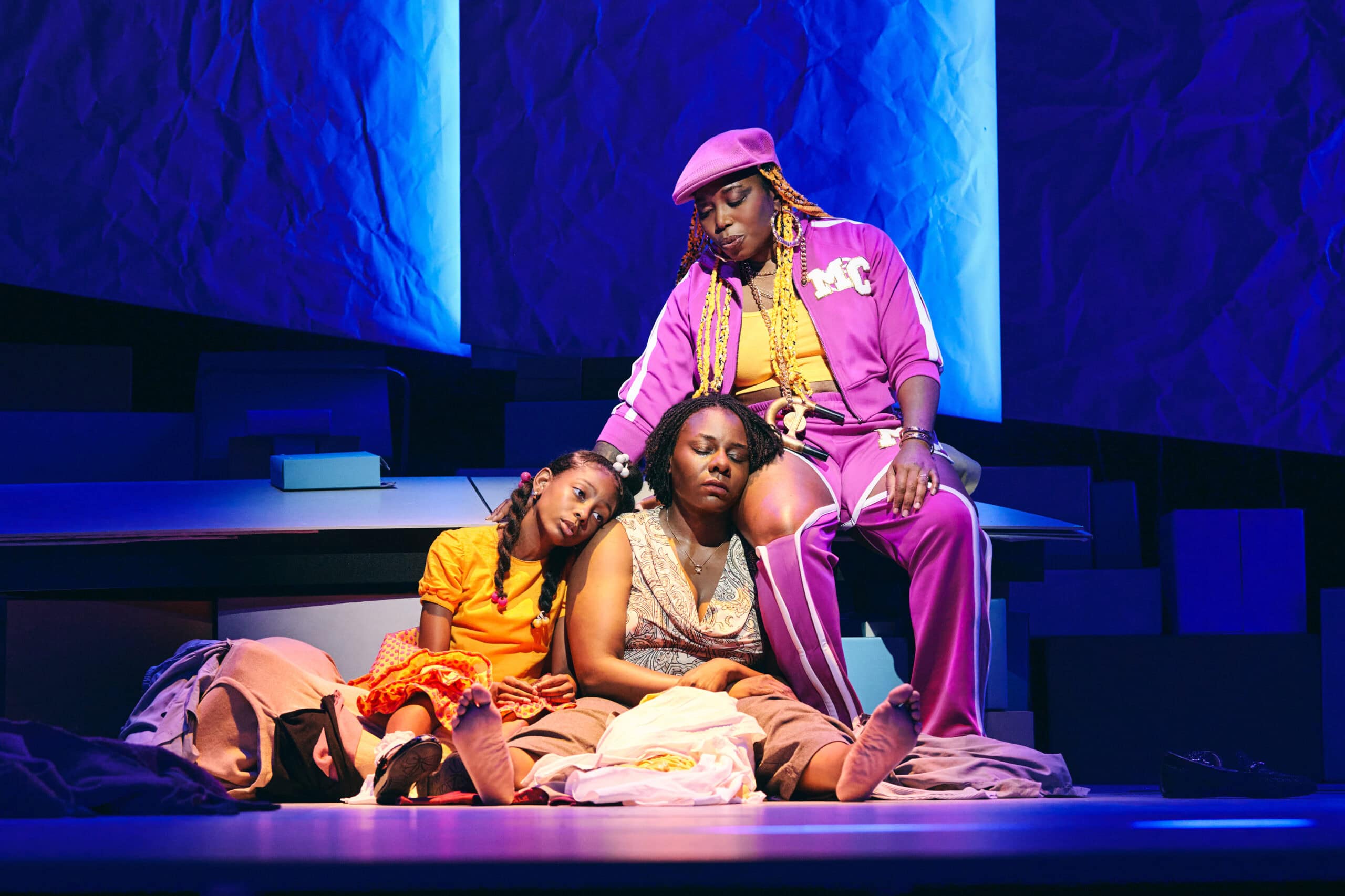
Savannah Commodore, Abigail. C. Onwunali, Donnetta Lavinia Grays in creation stories and all the important importants. Photo: Valerie Terranova
Meet Thegrownwoman. Yes, that’s the name (no typos) of the narrator/protagonist in creation stories and all the important importants (no caps), a fascinating autobiographical new play now playing at LCT 3. You’ll accompany Thegrownwoman through a day in her life—a day that will span her entire lifetime thus far, evoked by the mystical, mythical powers of this ambitious new work by Mfoniso Udofia, a Nigerian American playwright.
The bare-bones plot is simple. A woman wakes up, exercises and showers, talks to her mother on the phone, grocery-shops for her, stops by her doctor’s office for a blood test, and teaches a class on playwriting. All the while, she is awaiting the results of her intensive IVF treatments with anxious anticipation. She then receives a call from her doctor. and learns that she won’t be able to bear children. She summons the courage to call her mother and tell her the news.
That’s the story—but it is not told in a realistic style. Far from it! Udofia draws on her rich heritage to elevate and expand her protagonist’s story to a profound spiritual experience, transcending time and place.
The play begins just before dawn with a sleeping Thegrownwoman (the charismatic Abigail C. Onwunali). She is awakened by the dancing, chanting Raffia (an earth goddess of creation from Nigerian mythology). A starry night sky is projected against a multi-paneled upstage wall, as we hear the voice of “The Uncome” (a mythological star), issuing a warning about the upcoming day.
Then suddenly, this otherworldly scene fades away, and our protagonist awakes, emerging from a pile of jumbled bedclothes. We are in her apartment, and watch as she commands Alexa to stop her alarm and help start her day with her favorite music. Her morning prayer: “You just have to do it./ What you are made for./Create something./Anything.” As she exercises and chats with Alexa and Siri, she hints at the event that she’ll be facing with great trepidation: the results of the blood test that will determine her chances of pregnancy.
While Thegrownwoman exits to shower, another character emerges from the bedclothes. It’s Little Girl (a captivating Savannah Commodore). Who is she? And who is the invisible Mr. Cornell to whom she keeps referring? She doesn’t appear to be real, because Thegrownwoman, who eventually returns, doesn’t acknowledge her existence. Unseen, Little Girl squeezes into Thegrownwoman’s shopping cart, and off they go to Costco to shop for Thegrownwoman’s mother. After that, she stops at the doctor’s office for a blood test. She then arrives at her noon class on playwrighting, lecturing on “the well-made play” (with reference to a fictional female Nigerian playwright named Etienam Akpabio).
Ultimately, Thegrownwoman speaks with the doctor by phone and hears the shattering news. “This was the very best my body could do,” she admits, acknowledging that she will never be able to give birth.
But then she become able to see and hear the Little Girl—Thegrownwoman’s nine-year-old self. “I know we were made to create,” says the Little Girl, providing comfort and encouragement. At that moment Mr. Cornell appears too (played by Donnetta Lavinia Grays in shocking pink, costumed by Sarafina Bush). Mr. Cornell, it turns out, is a magical horse, an imaginary figure from Thegrownwoman’s childhood. Talking in rap, Mr. Cornell advises her on “how to create/what makes a play a play/exactly what creation comes from which kind of way . . . you are made for celestial things!” Together, Little Girl and Mr. Cornell urge Thegrownwoman to move on, to dream, to create., telling her: “All endings are new beginnings.” They nourish her with food and encouragement to keep writing, while a burst of stars floods the upstage panels.
Under Tamilla Woodard’s vigorous direction, the cumulative effect of this unique work, with its turbulent swirl of myth and reality, of poetic English and Nigerian phrases, is dizzying. Abigail C. Onwunali drives the story at a frenzied pace, alternately passionate and vulnerable, as she finds the courage and resources from her heritage and her past to face the present, look to the future, and fulfill the play’s title. As Little Girl, the captivating Savannah Commodore charms with her candor and strength. As Mr. Cornell, Donnetta Lavinia Grays plays the imaginary magical companion of Thegrownwoman’s childhood in rap verse (as well as the Raffia and the voice of Alexa), providing levity and love.
The impressive production values include a circular set designed by Jason Ardizzone-West, above which panels feature scenes of the sensational starry night (lit by Alan C. Edwards). Images of the characters themselves are also projected (design by Katherine Freer). It’s a stunning visual feast, and an arresting theatre experience.
Above all, the word “creation” has several meanings in this imaginative, exotic, far-reaching work: including creation of a new life and artistic creation. If she can’t succeed at the former, she can succeed at the latter: to create a new form, as this unique meta-play certainly is. Therein lies its “important importance”—both for the playwright and for the contemporary theatre. Creation stories is a metatheatrical exercise, unique in its confluence of myth, imagination, reality, and its blend of languages and narrative style.
Ultimately, my fascination for this courageous new work lies not only in its theatricality, but also in its place in the oeuvre of Mfoniso Udofia. This ambitious, determined playwright is near to completing her nine-play Ufot Family Cycle, an epic spanning generations across Nigeria and America that has played around the country. But creation stories is unique in her award-winning body of work. As she writes in the script’s poetic introduction: “This play came from a commission where I was asked to write /write exactly what I wanted/this play is what kept coming out of me . . . even when I did not want to write it. It nearly broke me/my brain, my heart, my body. Oh the pain of this. Oh the patience of this . . . know that this piece is incongruently fashioned from everything I am: ancestrally, artistically, creatively, spiritually, bodily . . . I have written myself to the edge.”