
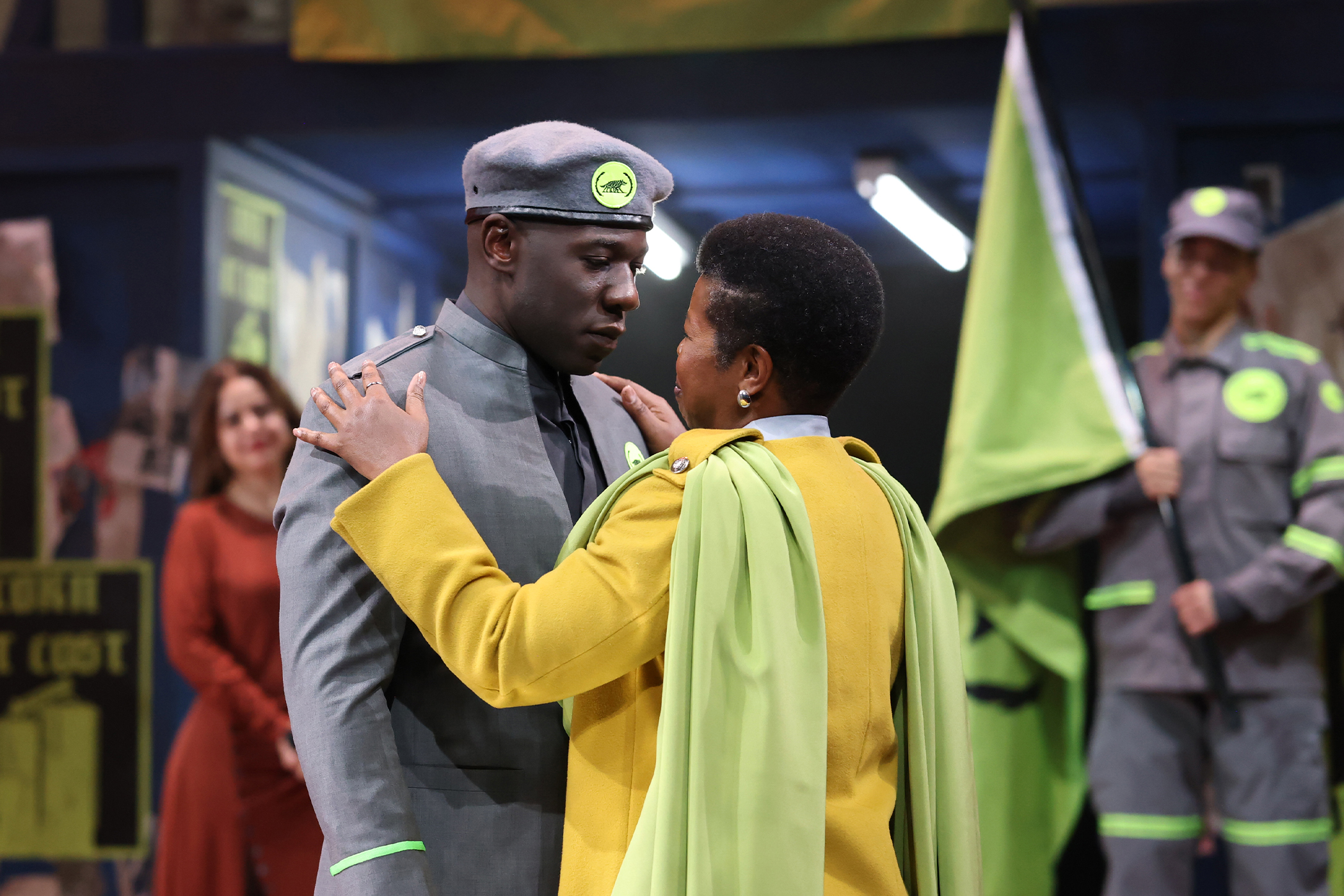
“The Tragedy of Coriolanus” at Theatre for a New Audience (Photo: Hollis King)
One path to a successful production of an old and not-great play is to excavate some element of the play that can resonate with a contemporary audience. Now, in a time of ever-widening divides between rich and poor and ever-increasing contempt from governments for the people they govern, Shakespeare’s Coriolanus would seem well-suited to that approach. The play is rarely produced because it is far from great, but it has much to say about the volatility that develops when people starving for respect clash with a government covetous of its own power.
The Tragedy of Coriolanus, now running at Theatre for a New Audience under the direction Ash K. Tata, seems well aware of and deeply invested in capturing the play’s contemporary resonance. Set “just after now” in what appears to be a dystopic Rome teetering on totalitarianism, the production looks hard for contemporary resonance. The effort proves unsuccessful: the show finds more dissonance than harmony between Shakespeare’s Romans and our world.
Set in the fifth century BCE, Coriolanus tells the legend of its namesake, a powerful Roman general and disastrous politician. Amidst a grain shortage in the city, the hungry and angry rabble demand reforms from the government they decry as elitist. Just as the politically savvy Menenius Agrippa (Jason O’Connell) begins to gain some sense of control over the dangerous unrest, Coriolanus (McKinley Belcher III) lays bare just how much disgust he and the ruling class have for the common people and their pleas. The great distraction of war interrupts this clash, giving Coriolanus the opportunity for greater glory, but his and his fellow nobles’ efforts after the war to raise the general to political heights fail spectacularly. To secure election as Consul, Coriolanus must appeal to the people. This proves too much for the self-assured general, and the ensuing clash ends with him exiled. Incensed, Coriolanus bands with Rome’s hostile neighbors, and the Eternal City, quaking at the prospect of his violent and destructive return, grows only more fractured as it searches for answers. The intervention of the general’s wife, Virgilia (Meredith Garretson), and especially his mother, Volumnia (Roslyn Ruff), will be crucial in finding a path forward.
Coriolanus is not Shakespeare at his best. Written later in his career when the playwright was growing increasingly verbose and melodramatic, the play is full of long, circuitous speeches amidst a plot lacking any great intrigue and built on characters without any real depth.
Tata’s production takes three full hours to get through the play, searching for a compelling hook somewhere in the modern setting, but consistently falling short. Belcher’s Coriolanus is precisely as bombastic and aloof as Shakespeare wrote him, which only makes the few glimpses of his humanity seem abrupt and jarring. O’Connell’s sleazy and conniving Menenius is a fun bright spot and the always excellent Ruff shows, with little doubt, why Volumnia is so adept at overpowering the emotions and intellect of her son. But, on the whole, the performances highlight rather than assuage the static nature of these characters.
Tata is after a Coriolanus for the moment, one that encourages audiences to attune themselves more sharply to the push and pull for power between the ruling classes and the people. It’s a fine idea, but not one that this production’s dystopian setting and modern dress articulates with much clarity. Instead, the show reminds us why Coriolanus so rarely sees the stage, at this or any other moment.