
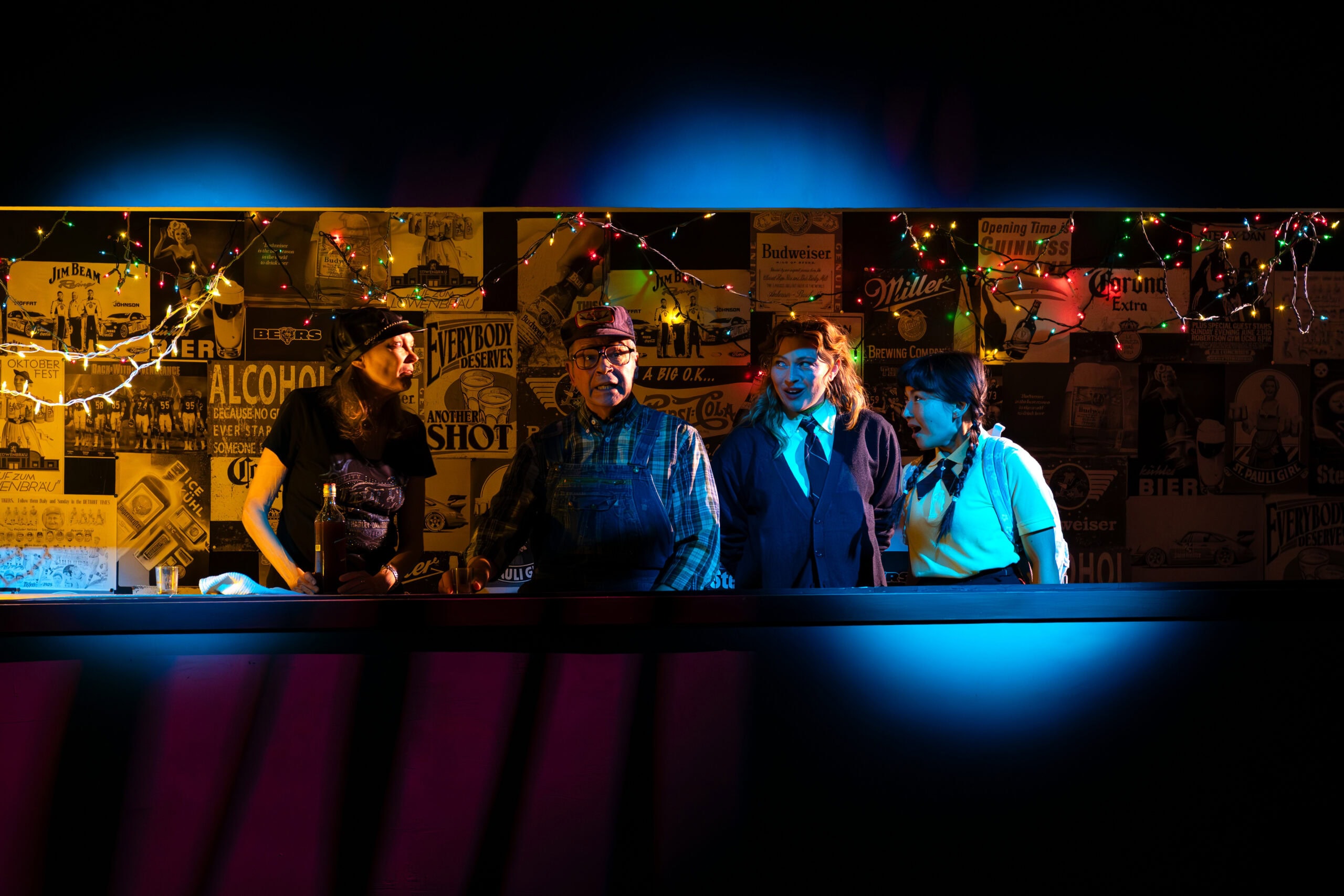
Rae C. Clarke, Gilbert Cruz, Piper Patterson, and Lennox T. Duong in Midwest Porn. Photo: Harrison Lubin
Plays are often vehicles for social, political, and/or cultural critique. Playwright Quincy Long has chosen an unusual target with his new play Midwest Porn, now being produced by The Tent: theatrical conventions. Long skewers some of theater’s long-held, commonplace storytelling techniques. I’m not sure why he is doing this, but I certainly enjoyed watching it.
The story of Midwest Porn is … weird. Fourth grade students of St. Mary’s Academy are distracted by the school’s possible imminent closure, and also the turtle infestation threatening their town. One of the fourth graders, Mikey (a straight-laced and unhinged Bubba Weiler; all the children are played by adults), is further upset by the pornography habit of his father Richie (earnestly portrayed by Matthew Maher). Mikey’s mother, Wanda (a wonderfully funny Danielle Skraastad), disguises herself in order to keep an eye on Mikey. Meanwhile, Mikey’s classmates struggle with fundamental questions, like “Who are these turtles and where do they come from?” Oh, and it’s a musical. Maybe.
Just as French fries are an excuse to consume ketchup, the plot, such as it is, is mere pretext for Long to play with the audience and make us question things we take for granted when we enter the theater, things like adult actors portraying children or people breaking into song for no reason. At first, Long and director Carolyn Cantor give little hints that undermine the very conventions they are employing: a costume choice, an unusual line of dialogue. They continue to unravel the reality they’ve constructed until they are ridiculing it, exposing it as a sham, and encouraging the audience to enjoy the joke that’s just been played on us. It’s good-natured ribbing, like a favorite uncle who tells you to pull his finger, then says he can’t believe you fell for that.
The cast commits fully to the silliness. In addition to Skraastad’s delightful performance, Rae C. Wright stands out as a hard-boiled school principal who “wasn’t always a nun,” and Piper Patterson does a fine turn as a fourth-grader navigating a crisis of faith. Director Cantor keeps things going at a steady clip— things may be strange but rarely are they boring. The set by Frank Oliva provides a versatility the small space requires and still finds some nice touches (water stains on the walls, a pop-up bar), and Mary Louise Geiger’s lighting design helps define the space and mood. Kudos to Heather C. Freedman’s costumes, which occasionally venture into ludicrousness.
Adherence to one’s faith and the mysterious presence of reptiles aren’t the only existential questions the show poses. It also asks, What constitutes a musical? From time to time, one or more actors will break into song. But does that make it a musical? The show self-identifies as a play with music, and absent are all traditional hallmarks of the musical, like volume, musical instruments, and storytelling. The numbers are straightforward affairs, pairing Long’s uncomplicated lyrics with Michael Chinworth’s simple melodies. As a debate topic, it may fall short of “how many angels can stand on the head of a pin,” but to theater-goers (and theatre-goers), the show walks an interesting line.
While Midwest Porn gave me things to think about (also, how much the Oedipus myth is powered by society’s fear of sex), I felt a little empty afterwards. I couldn’t figure out why the play was doing the things it was doing; I wanted there to be import where there may have been none. Perhaps probing for deeper meaning is another theatrical tradition Long is interrogating, but it’s one that I’m rather fond of.