
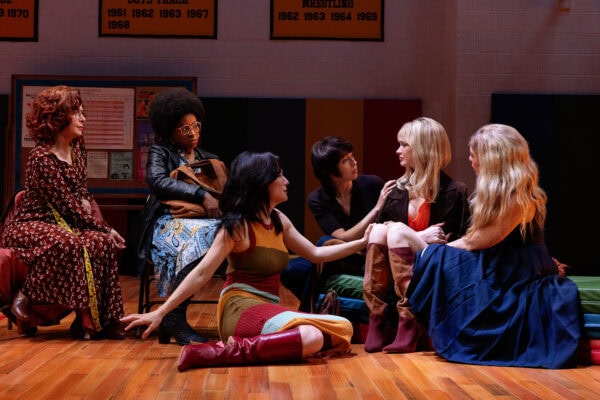
Cast of Liberation (Photo: Little Fang)
Years ago, I got into an argument with a millennial-age man about feminism. His view was that women just had to wait until the “old sexist guys” died out and that time would come, eventually. And I recall asking, not without some anger, how long I should have to wait to be treated equally?
Generational conversations about feminism are central to Bess Wohl’s sweeping play Liberation about second wave feminism. In it, her Gen X narrator looks back at her mother’s generation of feminists and wants to understand what happened and why everything today has gone wrong.
Funny, rigorous, and filled with meaningful questions, the play remains apt for our moment and is no less potent than its Off-Broadway run from earlier this year.
Lizzie (Susannah Flood) is both herself in the present day and her mother in the 1970s. Back then Lizzie, organized a women’s liberation consciousness raising group in the local rec center in Ohio. The other women responding to her flyers included Celeste (Kristolyn Lloyd), a Black Radcliffe grad who has moved from New York back to Ohio to care for her ailing mother, Susie (Adina Verson), a queer radical who is burnt out on the movement and now living in her car, Isidora (Irene Sofia Lucio) a Sicilian woman who had been involved in activism elsewhere until her husband from a green card marriage moved them to Ohio, Margie (Betsy Aidem) a long-suffering, empty-nester housewife who is ready to stab her husband, and Dora (Audrey Cora), a pretty, young secretary at a wine and spirits company, who thought the meeting was a knitting group but stays.
Through their conversations, arguments, and attempts at consciousness raising these women become friends of sorts but they also reflect the tensions in the movement. Isidora is forever bemoaning the lack of action. Celeste is questioning whether the white women are even thinking about Black liberation. Lizzie is frustrated by the group taking on a life of its own and her own internal conflicts when she gets into a relationship.

Cast of Liberation (Photo: Little Fang)
The play delves into tough questions like where does activism take us and where will real change come from. And there are also self-reflective moments about playwriting, representation, and what role these Black characters have in this white woman’s play.
The play reflects Wohl’s roots in the investigative theater, The Civilians. She brings in documentary theater elements through present-day Lizzie interviewing some of the women from her mother’s group now. Through design, the interviews are slightly set apart from the rest of the action. Cha See’s lighting cools those moments and Palmer Hefferman and Ben Truppin-Brown’s sound design suggests a slight tape hiss.
But also the richness of each of the characters makes them feel like “real” people our mothers may have known back in 1970. The ensemble is strong across the board and the performances have just gotten richer.
I often think of Claudia Shear’s play Blown Sideways Through Life and her killer line: “Everyone has at least one story that will stop your heart.”
Here, Wohl teases out those stories and it is a pleasure to hear them. While the play centers on the Lizzies past and present, the rest of the characters are not getting a full arc, but at the same time they are given so much clarity and presence that we can fill in the gaps for ourselves.
And when the focus shifts to different women they are each interesting in their own way. And they do not feel like representations of a kind of a woman but women full of internal contradictions, life experience, and pain.
Whitney White’s direction also helps to layer what is unsaid among them. With certain glances and interactions, secret dynamics are established. Costuming (by Qween Jean) hints at the characters evolving before our eyes (Dora goes from flouncy dresses to an increasing awareness of her body and self-expression).
In a way, the Lizzies are the least interesting characters. I understand you need a sort of maudlin set-up to kick off the memory play (Lizzie’s mother is no longer alive so she is forced to speak with all these other women to understand her mother). But 1970 Lizzie’s relationship with the man who becomes present-day Lizzie’s Dad, Bill, is maybe one of the more frustrating or infuriating beats.
The energy of the room and play changes once Bill (Charlie Thurston) walks in. It does not derail the play but it ends up leaving Lizzie more reactive and unexplored. We are supposed to be left with the same questions as present-day Lizzie about the choices her mother made. But it slightly pushes into me not liking these characters at all and not caring about their choices.
But that quest to understand our mothers is maybe universal. The play did get me thinking about my mother’s place in this particular history. It is impossible to be a Gen X women and not know how our mothers belatedly came into their rights to bank accounts and credit cards. But as the Free to Be You And Me generation who lived through Reagan and then the culture wars of the 90s, it would be generous to say we received mixed messages about feminism and where the movement was going.
One of the reasons I wanted to revisit the play was a line that has stuck in my craw for months where Lizzie’s mother blames her daughter’s generation:
“I mean, your whole generation. It was a huge problem for us, the having you, the raising you, and the way you took so much for granted and let so much slide.”
First off, the Boomers are still alive and voting so I’m not sure exactly what Gen X is wholly responsible for (also Gen X has some of the lowest birth years on record). I think the disillusions we experienced were also inherited. At the same time, we saw women torn down in front of us day in and day out through the media. Nothing felt taken for granted. But everything felt like a fight and one we kept losing time and time again.
Ok. I had to get that off my chest. I think every generation is confronted with some of the same fights but they take different forms. Workplace sexism might look different today from my mother’s era but it still exists. I do not think the point of the play is to perpetuate the feminist generation in-fighting. But to all agree that things are not good in the world, the rollback of rights for women is horrific, and anyone believing tradwife bullshit is the way to go should have their heads examined. But I am also wondering if standing outside with a No Kings sign is enough either.
And this play is part of that conversation and it is important to even be having the conversation.