

Will Brill, Thomas Jay Ryan in Kramer/Fauci (Photo: Maria Baranova)
Kramer/Fauci is somewhere between a time capsule of AIDS policy in the 90s and a moment of reflection on post-pandemic political life. It seems crazy that Anthony Fauci’s career would stretch this far and he ends up a central figure in both.
Daniel Fish has conceived and directed this sometimes absurdist take on a 1993 C-Span debate between firebrand, playwright Larry Kramer (Thomas Jay Ryan) and the even-keeled Dr. Anthony Fauci (Will Brill) who was Director of the National Institute of Allergy and Infectious Diseases, at the National Institute of Health at the time.
You can watch clips of this original debate online. Fauci was in the studio with the moderator and Kramer was on an ear-piece only able to hear but not see who he was talking to much to his frustration.
In this rendering, Fish has them standing on the massive Skirball stage. The unnamed moderator (Greig Sargeant) is in a rolling office chair asking questions and taking callers. And various Americans (all played by Jennifer Seastone) dial-in to ask questions or give comments on the AIDS epidemic (or plague as Kramer thinks it should be called). All the actors use earpieces to stay on pace with the brisk TV episode.
Central to the debate is that Fauci is both friend and foe to Larry Kramer. Long critical of Fauci, Kramer expresses his love for Tony and at the same time he gets so frustrated with him. They are fighting a battle together and against each other. They understand each other and yet cannot always agree. There is affection, anger, rage, resignation, and resistance.
What moved me most was the complexity of this dynamic between these two men. And the nuance to which this relationship operated. Kramer could appreciate the multiple hats Fauci wore as doctor, scientist, and public health official but he seethed whenever Fauci would fall into political bureaucrat speech.
Fauci walks a delicate path (which Kramer acknowledges) to try to fight for what he needs for the research and at the same time manage the political atmosphere he is in. He must be diplomat between factions that have little common ground.
Kramer needs there to be action and not discussion. The delays over drug protocols, the indifference to the people dying, and the contempt at gay people because of this “gay disease” as it was called at the time. It is a matter of survival and a matter of principle that Kramer is fighting for.
It was startling to realize how many names from the era I remembered (though the program handed out at the end of the play offers a cheat sheet). I left wondering how many young people today even know who Ryan White was. While I was a teenager in 1993 and I might not have known the politics at play, I was aware of the conflicts. It was still the time of monolithic mainstream media.
I appreciate that this play exists so that we can take a moment to spend time with these voices in this moment in history. I’m not sure people who did not live through it understand what it was like–the fear, the protests, the shame, the bigotry. So these glimpses are important.
Though Fish’s staging was more puzzling than intriguing. The line delivery from Seastone and Sargeant in particular ends up a kind of intentional stylized monotone. I had no idea who the voices were that were being embodying. And at some point Seastone is in roller blades and another moment in a chicken suit.
Fish allows for moments where the characters briefly interact with each other but more often than not they are, like Kramer with only an earpiece, a bit adrift in the space not knowing where to face or speak.
Ryan as Kramer paces, hugs the giant proscenium column, gets in various peoples (or chickens) faces. Brill as Fauci has a more chill energy, but challenges Kramer and pushes back at his exaggerations. He is listening to everything Kramer says and never loses his cool, delivering gentle pushback with Fauci’s Brooklyn accent.
But Fish placing them in this disembodied purgatory had little impact. The power of the show ultimately comes from Kramer and his fury and humor. The debate itself and the men who are locked together in this lonely place constantly arguing for the perspectives the American public refuses to hear or see.
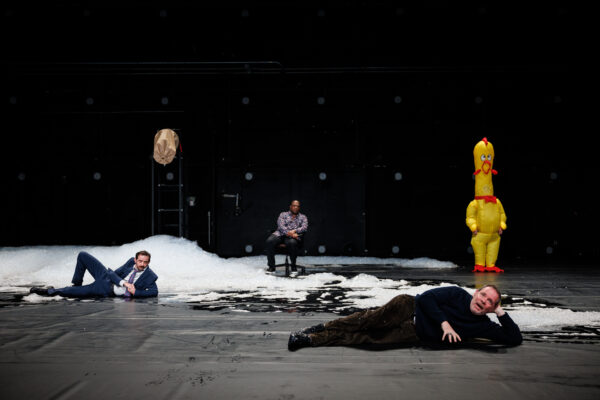
Will Brill, Greig Sargeant, Thomas Jay Ryan, Jennifer Seastone in Kramer/Fauci (Photo: Maria Baranova)
And then there is the bubble machine. When it got wheeled out, I truly had no idea what this contraption was. And once it got going creating a tidal wave of suds…I kind of loved it. Though I am sure others might find it gimmicky. There was something simple and beautiful with this billowing, cloud of bubbles that envelopes Kramer.
But the play does not end there. So the magic bubbles burst and then it’s puddles and squeegees. Deflated reality is messy.
Mostly I just wanted these men to talk. They didn’t need any kind of additional gloss. Brilliant, troubled, facing something unfathomable…I wanted to hear from them because there is so much power in their words.
Then there are parallels to the COVID pandemic. Kramer complaining about the way people are shitty to one another. How egregious the New York Times is. And most of all how whatever came before in his life, he no longer remembers it as he is deep in his activist fight because of AIDS.
And there was something in that moment that broke me. The idea of AIDS as a cleave in a generation (from Randy Shilts’ And the Band Played On) is not new to me. While I lived through this era, it was as a child and a teen not fully comprehending what was happening. But the pandemic of my adulthood has re-written so much of myself, the world around me, and how we move forward.
I am not the same person I was in February 2020. I used to joke I went into the pandemic with straight hair and a vague understanding of where Korea was, and came out of the pandemic with curly hair and speaking Korean. While I jest about these surface things (which are indeed true), the idea that your past becomes so divorced from your present makes complete sense to me now.
I don’t know that Kramer or Fauci have answers to the issue of where we go from here. But we can look to these men and see how they faced this unbearable uphill climb and just kept going anyway.