
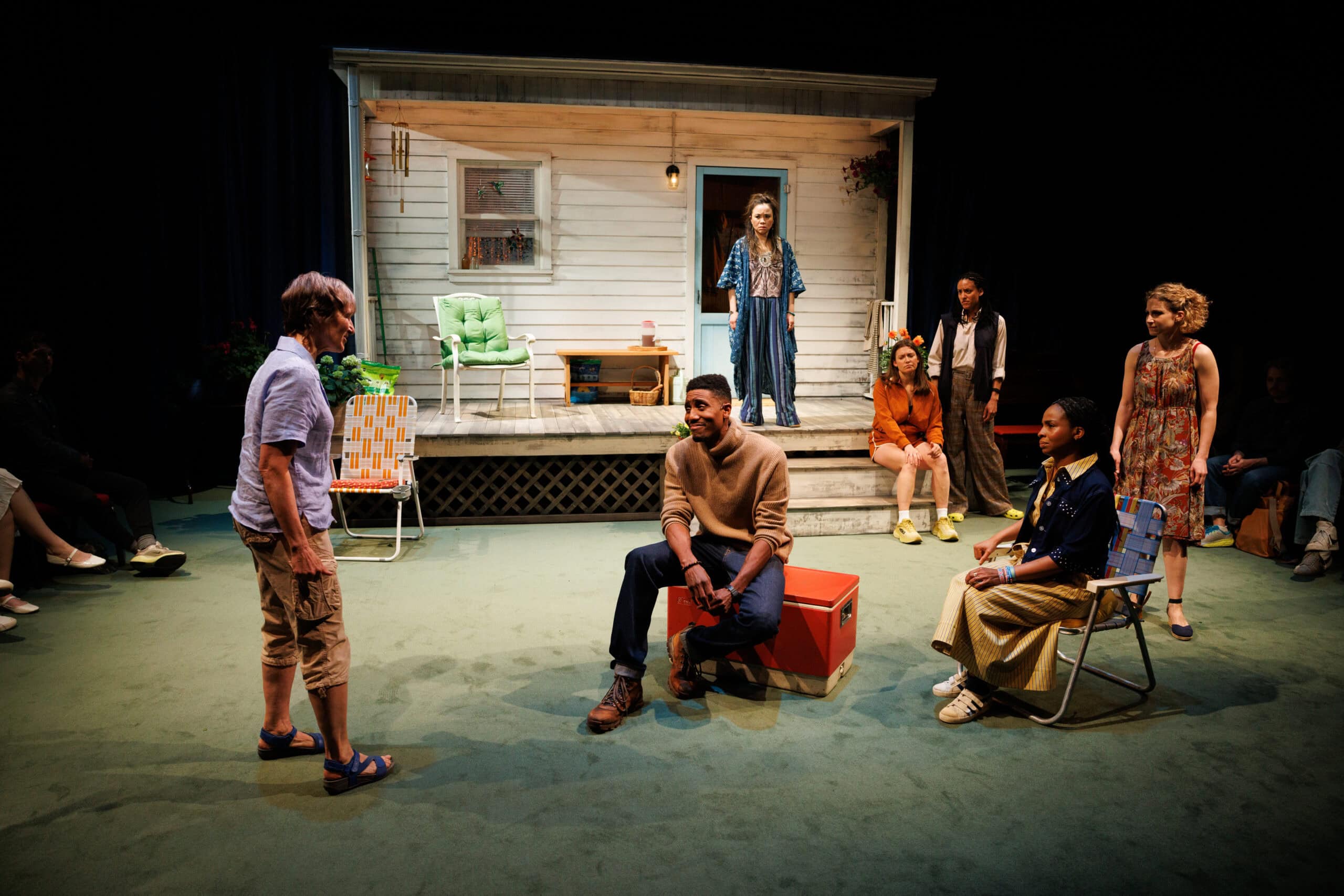
Dee Pelletier, Gabriel Brown, Tina Chilip, Lucy Kaminsky, Brittani K. Allan, Morgan Siobhan Green, and Zoe Geltman in A Woman Among Women. Photo: Maria Baranova
“We need new forms! We must have new forms! And if we don’t, we might as well have nothing at all.” Sitting in the Claire Tow Theatre at Lincoln Center, watching Julia May Jonas’s A Woman Among Women, that cry from another play kept echoing in my head. It came from the passionate young playwright Treplev in Anton Chekhov’s The Seagull, whose new play is about to be performed in a high-stakes premiere.
Like Treplev, Jonas is a determined writer, whose mission, according to the program, is to write a “five-play cycle in response to five canonical male-experience plays.” This one, she says, is inspired by Arthur Miller’s All My Sons. (For more background, see editor Loren Noveck’s review in Exeunt NYC of the play’s premiere at the Bushwick Starr last season.) It’s an ambitious mission, and this particular play has a compelling story to tell. It also has a striking “new form,” like Treplev’s play, that can get in the way of the storytelling.
Set in Northampton, Massachusetts, the piece takes place in the backyard of Cleo (Dee Pelletier), a psychologist. She’s a caring, compassionate, responsible member of the community who has created a local wellness center for women where her daughter Grace (Zoe Geltman) also works. One by one, we meet her neighbors, who respect and admire her. As they gather, however, there’s a growing issue that concerns them all: the fate of Cleo’s other daughter, Jo, who suffers from bipolar disorder and is currently serving a prison term for assaulting a seventy-year-old neighbor and crippling him for life. Several community members are pressing for a review of Jo’s case with the hopes of commuting her sentence, an effort led by lawyer Christine (Brittany K. Allen) and Tina, Cleo’s non-romantic life partner (Tina Chilip), who helped raise Cleo’s daughters.
But Cleo is against these efforts, intent on keeping Jo locked away so that she can cause no further harm to her neighbors and her family. Roy, Jo’s husband (Gabriel Brown), sides with Cleo; he has come back to Northampton to retrieve his belongings now that Jo is in prison. He doesn’t want Jo to be freed either, for fear she’ll want to visit their young daughter, whom Ray is now raising. Meanwhile, he’s developing a romantic relationship with Jo’s sister, Grace.
Yes, it’s complicated, and it gets even more so as gradually we learn that Cleo feels responsible for Jo’s violent crime (shades of Joe Keller, Miller’s protagonist. No spoiler alert, it’s yours to discover why). Ultimately, the conflict crescendos to a crisis, isolating Cleo from the community she has worked so hard to create.
The “new form” that Jonas has created to tell her story is indeed an arresting one. As directed by Sarah Cameron Hughes, the production is divided into three “phases.” (I’m not sure what else to call them, since I’ve never seen this kind of dramatic form before. They are not separate scenes, since the action continues uninterrupted throughout.) Before the play begins, we enter an empty performance space, whose bare floor is surrounded on three sides by audience seating. One by one, the characters enter, carrying folding chairs which they place next to audience members—and voila, Cleo’s backyard is created, and we are a part of it. At first, they interact in an amicable, neighborly way, until the conflict escalates and details of Cleo’s guilt are revealed. Suddenly, the upstage curtain parts, and a huge construct of Cleo’s back porch rolls forward to fill the playing space. The action continues uninterrupted, but now we’re watching a play staged on a conventional set (designed by Brittany Vasta). No sooner do we adjust to this new setting than a third change occurs. The ensemble members suddenly don period costumes suggesting colonial style (designed by Wendy Yang) and engage in a traditional folk dance, while Cleo, isolated, sits alone on her porch.
I left the theatre unsure of how these three phases served the story.
A second issue is the presence of music. Lane, a guitarist (Drew Lewis), offers several original songs that are a welcome element, but are curiously infrequent, tentative and muted. At one point, for no apparent reason, Lane stops the narrative and invites the audience to clap together in various rhythmic patterns. For what purpose, it’s unclear.
In all, there is an incomplete sense to A Woman Among Women, which—in my view—turns out not to make the feminist statement I had anticipated based on the playwright’s own words. Instead, what this play and production do offer is a strong sense of community, created by the heartfelt interaction between characters who truly care about each other and share responsibility for each other’s lives and well-being. The image of Cleo sitting isolated on her porch is a shattering one, indeed.
As Samuel Beckett says, “Form is content; content is form. Writing is not about something; it is something.” Perhaps that quote can illuminate the mysteries of this ambitious new work.